Anne Newland, MD, MPH, has worked for more than two decades in clinical medicine, and also in healthcare administration and leadership, including outpatient and emergency care from August 2004 to May 2012 at Kayenta Health Center on the Navajo Nation, a clinic about 70 miles by road from the closest hospital. Thomas H. Lee, editor in chief of NEJM Catalyst1, has described rural settings as a proving ground where new ways of organizing care are tried before they spread.
One such model is a video visit that joins two clinics. According to Jeremy Cauwels, chief physician of Sanford Health, the Dakotas have only five pediatric pulmonologists, and a family in Dickinson, North Dakota, lives 6 or 7 hours from the one in Sioux Falls, South Dakota1. Sanford links the two sites so the specialist can examine a child's heart and lungs on screen while the parent and a Dickinson provider sit in the room. All three hear the findings at once. The idea runs through every newer rural model: move expertise rather than the patient, and keep the local clinician involved.
Specialists reached by video
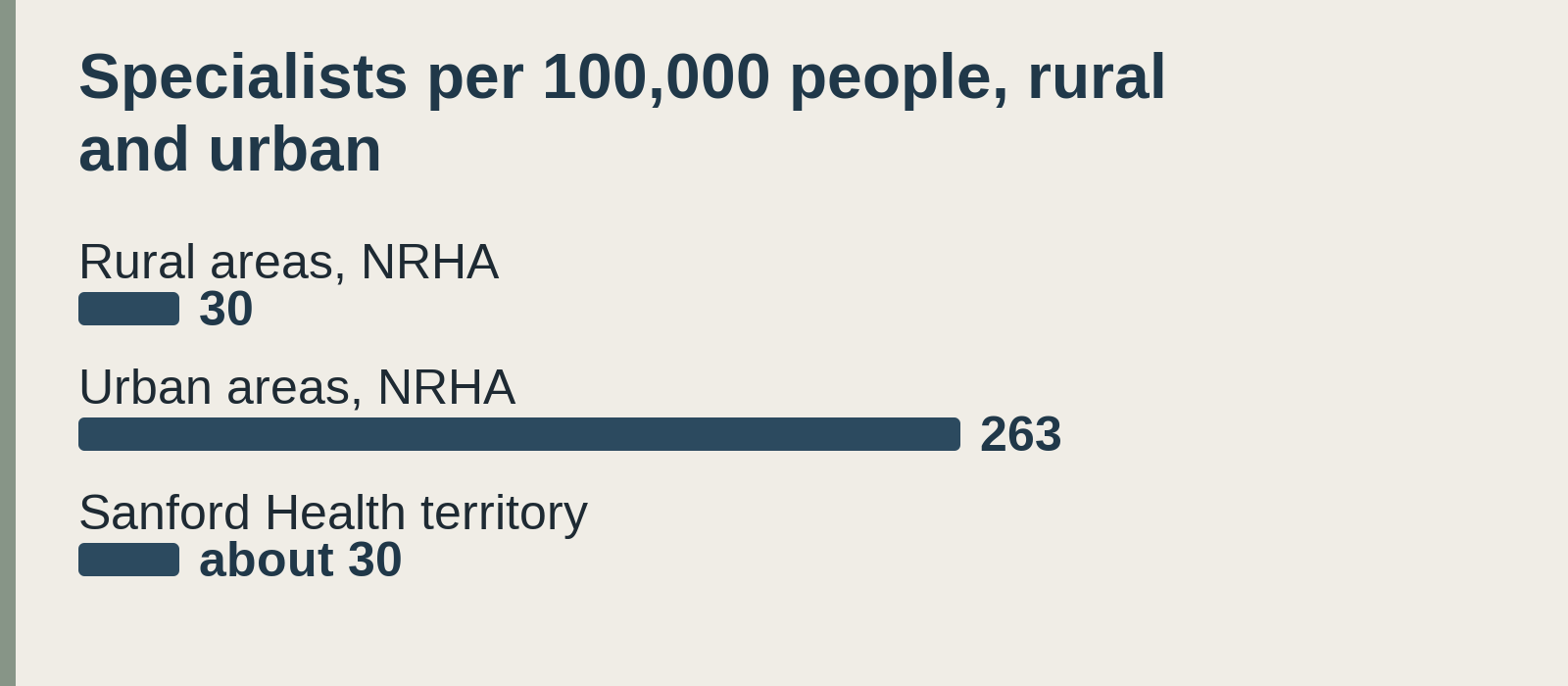
National Rural Health Association figures cited in a 2023 STAT documentary2 put rural areas at 30 specialists per 100,000 residents, against 263 per 100,000 in urban communities. Cauwels gives a similar contrast for Sanford, roughly 30 subspecialists per 100,000 people where an average metropolitan area has about 300 to 320, spread over a territory of about 250,000 square miles1.
Video changes the shape of a specialist's week. One Sanford endocrinologist in Fargo keeps about 20 percent of his visits virtual, and in winter the share rises to 40 percent or more, so patients who cannot safely travel still keep their appointments1. The STAT series followed a Fargo endocrinologist, David Newman, and an obstetrician colleague, Johnna Nynas, as they paired virtual appointments with remote monitoring for patients hundreds of miles away2.
Obstetrics offers a sharper case. Around Bemidji, Minnesota, Cauwels says, some patients live 120 miles from their obstetrician, so Sanford used a federal rural maternity grant to offer nonstress tests, the monitoring belts placed around a pregnant patient's abdomen, in local emergency departments and sometimes at home1. A patient without steady internet service can record the test and upload it later from a coffee shop or grocery store. Even after the pandemic, about 20 percent of Sanford's mental health visits still happen on a virtual platform.
A hub hospital that lends its experts
Larger systems have extended the idea from single appointments to whole hospitals. Dan Liljenquist of Intermountain Health told NEJM Catalyst3 that Intermountain supports small hospitals through what it calls a virtual hospital, a hub and spoke arrangement that supplies tertiary and quaternary specialty care by telemedicine. He tells of a stroke patient at a supported hospital in Alaska who, by his account, received clot dissolving drugs faster than any academic center would have managed. In December 2024 Intermountain joined Microsoft, Gates Ventures, Epic and West Health in a coalition aimed at rural care.
Prathibha Varkey, president of Mayo Clinic Health System4, describes 16 hospitals in Minnesota and Wisconsin that now operate as a single hospital with many entrances. A central command center, assisted by artificial intelligence, routes each patient by distance, severity of illness, staffing and open beds. Its Advanced Care at Home program treats admitted patients in their own homes under remote monitoring, and once a protocol based AI model began flagging eligible patients in the record, enrollment from the emergency department rose from about 1 in 10 to 4 in 10.
Bill Gassen, writing in a 2024 STAT opinion piece5 as head of what he called the country's largest rural health system, argued that rural providers are pioneering uses of artificial intelligence. He noted that rural counties grew by a quarter of a percent from 2020 to 2022, a gain too small to ease the harder task of recruiting clinicians in scarce specialties. How these links reach night shifts is covered in emergency care in remote places.
Sharing people across the map
Childress Regional Medical Center, profiled by STAT in 20176, shows shared staffing inside a single 39 bed hospital in the Texas Panhandle, 220 miles northwest of Fort Worth. Since 2013 an oncologist from Texas Tech University Health Sciences Center has driven the 150 miles from Lubbock at least monthly and supervises a local nurse trained to give chemotherapy, so patients no longer travel more than two hours each way for treatment. With no dedicated obstetricians, nearly all of its eight family physicians deliver babies. Since 2015 a video cart has linked its emergency room with Children's Medical Center Dallas, and a second unit connects the primary care clinic with cardiologists and psychiatrists in Lubbock.
| How it works | Example | |
|---|---|---|
| Video specialty visit | A distant specialist examines the patient with a local provider present | Sanford Health, Dickinson to Sioux Falls |
| Virtual hospital | A hub supplies specialist telemedicine to small hospitals | Intermountain Health |
| Hospital at home | Admitted patients are monitored in their own homes | Mayo Clinic Health System |
| Visiting specialist | A specialist comes on a schedule and supervises local staff | Childress Regional oncology clinic |
| Embedded professional | A psychologist works inside a family practice | Harpers Ferry Family Medicine Center |
| Returning retiree | A retired doctor takes part time shifts at a rural health center | Escalante, Utah, and Cooperstown, New York |
Embedding is another way to share a scarce professional. PBS NewsHour's 2023 Rural Rx report from West Virginia7 found clinical psychologist Samantha Deamer working inside the Harpers Ferry Family Medicine Center, so patients can see her in the practice they already use; at her outpatient clinic, adults waited about a year and a half. Software can stretch staff as well. Mayo used an AI triage tool to move about 30 percent of colonoscopy patients from anesthesia by nurse anesthetists to sedation by nurses, adding 150 procedures a month in Eau Claire, Wisconsin4.
Some clinics fill their schedules with doctors who had already retired. The Daily Yonder reported in 20258 on Jeff Chappell, a family physician who left retirement to work part time at the Kazan Health Center in Escalante, Utah, and on Douglas DeLong, 73, who returned to practice two or three days a week in Cooperstown, New York. The story cited a projected national shortage of as many as 86,000 physicians by 2036, the pressure traced in the rural doctor shortage.
What technology cannot replace
Every model above rests on infrastructure that many rural places lack. Varkey notes that many rural communities still have no broadband, a hard limit for any plan built on digital care4. Cauwels adds that farmers rarely come in during harvest, so a virtual visit from the farm may be the only one they keep1.
“these tools are not meant to substitute physicians or care providers”Prathibha Varkey, president of Mayo Clinic Health System, in NEJM Catalyst, New England Journal of Medicine
The leaders who run these programs stress their limits. Varkey says her system deploys AI only after extensive validation, because such tools can introduce new kinds of errors, and treats them as supplements that leave clinicians room for empathy and nuance4. Liljenquist makes a related point about scale: specialists cannot simply be trained and placed in every town, so Intermountain lends their knowledge through telemedicine instead3.
What the screens leave out is the clinician who lives in the town. Nancy Babbitt, a physician in Wayne County, Utah, where health centers cover 7,600 square miles, told the Daily Yonder that rural doctors build bonds lasting years, down to wedding invitations from children they delivered8. At Childress, STAT found a staff of 250 woven into ordinary life, with one doctor swapping shifts to watch his son play high school football6. A video link can bring a pulmonologist into a Dickinson exam room, but the family still depends on the small town primary care provider who will be there next week. Federal care in tribal communities is the subject of the Indian Health Service.
References
- Care Innovations for Reaching Rural Populations | NEJM Catalyst. New England Journal of Medicine.
- Treating Rural America: The telehealth solution. STAT, 2023.
- Collaborating to Affect Change for Rural Health Care with Innovation and Technology | NEJM Catalyst. New England Journal of Medicine.
- Leading Transformation in Rural Health: How Mayo Clinic Health System Is Redefining Care, Culture, and the Use of AI | NEJM Catalyst. New England Journal of Medicine.
- AI and rural health care: A paradigm shift in America's heartland. STAT, 2024.
- In a small town in Texas, a rural hospital thrives against all odds. STAT, 2017.
- West Virginia doctors work to bridge healthcare gap in rural areas. PBS, 2023.
- Retired Doctors Step Up in the Face of a Rural Health Care Crisis | The Daily Yonder. The Daily Yonder, 2025.
Further reading online
- New England Journal of MedicineCare Innovations for Reaching Rural Populations | NEJM Catalyst
- STATTreating Rural America: The telehealth solution
- PBSWest Virginia doctors work to bridge healthcare gap in rural areas
- The Daily YonderRetired Doctors Step Up in the Face of a Rural Health Care Crisis | The Daily Yonder
Related entries
The Rural Doctor Shortage
Seventy years of counting doctorless towns, and the reasons young physicians settle elsewhere.
The American Country Doctor
From buggy rounds to the board certified family physician, a century of the small town generalist.
Emergency Care in Remote Places
Volunteer ambulances, scarce emergency physicians and the debate over who should staff a small emergency room.
