
Anne Newland worked for the Indian Health Service from August 2004 to May 2012 as a physician at Kayenta Health Center on the Navajo Nation, where she led the medical staff between 2007 and 2009 and, from October 2008, served as its acting clinical director. The agency she worked for exists because the United States took on an obligation to tribal nations and later gave that obligation an office, a staff and a budget.
The obligation was framed plainly in 2010. When the administration backed an exemption for Native people from any penalty for going without insurance, the agency's director, Yvette Roubideaux, explained the reasoning: tribes had already paid for their health care by giving up their land, as she told KFF Health News in a 2010 interview1. The Indian Health Service is the federal agency built to carry out that bargain.
Where the agency came from
Federal medical care for tribes is older than the agency. The journalist Mark Trahant, writing in a 2009 ICT column on what he called the Indian Health Service paradox2, traces it back more than two centuries, first to the War Department and then to the Bureau of Indian Affairs. Congress moved those duties into a new Indian Health Service in 1955, and the agency now sits inside the federal health department, HHS1.
Everett Rhoades, a Kiowa physician, became the first Native American to direct the agency, holding the post from 1982 to 1993, according to an ICT profile of Rhoades at 803. He arrived as the agency faced its first budget cuts and was told to fix its management. He concluded that the management was sound and that officials above him did not grasp how hard it is to deliver care to several hundred sovereign nations at once3.
- 1955Congress moves Indian health care from the Bureau of Indian Affairs to a new agency
- 1960sThe agency begins building water, sewage and solid waste systems
- 1982Everett Rhoades becomes the first Native American to direct the agency
- 1997The Special Diabetes Program for Indians begins
- 2010The director reports more than 600 hospitals, clinics and health stations
- 2018GAO finds one in four clinical provider jobs vacant
- 2023GAO finds about 61 percent of rated buildings in fair or poor condition
Who can use the Indian Health Service
In 2010 the agency was responsible for about 1.9 million American Indian and Alaska Native people belonging to 564 federally recognized tribes, most living on or near reservations in 35 states1. Trahant counted nearly two million people in 36 states2, and by 2018 the Government Accountability Office described the eligible population as members or descendants of 573 tribes4. The figures move as tribes gain federal recognition, and the health conditions behind the demand are measured in health gaps for American Indian people.
Recognition is the hinge. Being an American Indian citizen of the United States does not by itself open the door, Roubideaux noted, since some Native people have access to the agency and some do not1. A writer from a state recognized tribe described in an ICT opinion piece on the rights and privileges of Indian health care6 being turned away from an Indian medical center for that reason. The same piece lays out a stricter rule for referral care bought from outside providers: patients generally must live inside a designated delivery area and belong to a federally recognized tribe6.
How the system is organized
Care runs through hospitals, clinics and small health stations, more than 600 of them by Roubideaux's 2010 count1. They are grouped into regional areas. GAO's 2018 review covered the eight areas where the agency provides substantial direct care4, and a later GAO study found federally operated facilities in ten5. With more than 15,000 employees, the agency was the single largest employer in Indian Country in 2010, according to a High Country News essay by Trahant7.
One region's arrangement is traced in health care on the Navajo Nation. When a patient needs a service the local facility cannot offer, the agency buys it from outside doctors and hospitals. Trahant noted that this purchased care is where shortages bite hardest, and that it often amounts to rationing2. Insurance helps fill the gap: Roubideaux said that in some facilities more than half the budget came from billing Medicaid, Medicare and children's health insurance for covered patients1.
Tribes and the agency share the work
Tribes can contract to run services the agency would otherwise deliver itself7. Trahant expected health reform to speed that shift, because Medicaid and other revenue would make tribally run clinics more viable, and he predicted the agency's own workforce would shrink over a generation while it kept a role in standards, shared medical information and funding7. He also pointed out that a state is reimbursed in full when a Medicaid patient is treated in the Indian health system, which gives states a stake in keeping that system strong7. Roubideaux, for her part, named partnership with tribes as her first priority as director1.
What the system can point to
The agency's record includes results that reach beyond the exam room. From the 1960s it invested in reservation water, sewage and solid waste systems, and the Congressional Research Service credited that work with an 80 percent drop in gastrointestinal disease among Native people since 19732. The Special Diabetes Program for Indians, begun in 1997, was linked to a 40 percent reduction in complications such as kidney disease and retinopathy2.
Public health work on reservations has produced similar results. In 2020 the White Mountain Apache Tribe in Arizona was infected at more than ten times the statewide rate, yet its death rate was 1.3 percent against 2.1 percent for Arizona, which epidemiologists linked to intensive contact tracing by teams that included doctors, as The New York Times reported in 20208. How tribes organize that work as governments is the subject of tribal public health.
“trying to deliver the same or better care with half the funding”Donald Berwick, quoted by Mark Trahant in ICT, ICT
Staffing and buildings fall short
People and buildings are where the shortfall shows most clearly. In November 2017 the vacancy rate for physicians, nurses, dentists, pharmacists and other clinical providers averaged 25 percent across the eight direct care areas and ran from 13 to 31 percent, according to a 2018 GAO report on provider vacancies4. Officials blamed remote locations, scarce housing for staff and salaries that could not match local markets. Temporary contract providers filled some gaps at higher cost and with less continuity, and GAO asked the agency to track what they cost, a step it had taken by 20214.
The buildings are aging too. A 2023 GAO report on facilities and equipment5 found federally operated medical buildings ranging from 1 to 171 years old, with a median age of 39 years. Of 212 rated buildings, about 61 percent were in fair or poor condition, against a goal of 90 percent in good or excellent shape. Equipment records were incomplete, so the agency could not say what needed replacing; after the review it made installation and end of life dates mandatory fields5. Recent replacements are described in health facilities in Indian Country.
The promise and the budget line
Trahant compared spending per person in 2009. The agency spent about $2,130 for each person it served, close to the average among industrial nations, while federal spending ran $3,242 per prison inmate, $4,653 per veteran and $7,784 per Medicare beneficiary2. Tribal leaders, he wrote, describe the result as a system that is starved rather than broken2.
Budgets have risen at times. The agency received a 13 percent increase for fiscal 2010, its biggest jump in 20 years, and the request for 2011 was $4.4 billion1. Yet the population it serves keeps growing, rural care keeps getting more expensive, and Rhoades recalled taking office just as the first cuts arrived3. The promise behind the agency has no expiration date. The budget line is written again every year, and in most years it has covered less than the promise implies.
References
- Indian Health Service Director Roubideaux: 'We Have A Lot To Teach The Country' KFF Health News. KFF Health News, 2010.
- Trahant: The Indian Health Service paradox. ICT, 2009.
- Revolutionary Rhoades: At Age 80, the First Native IHS Director Is Still Improving the Indian Health System. ICT, 2012.
- Indian Health Service: Agency Faces Ongoing Challenges Filling Provider Vacancies | U.S. GAO. U.S. Government Accountability Office.
- Indian Health Service: Many Federal Facilities Are in Fair or Poor Condition and Better Data Are Needed on Medical Equipment | U.S. GAO. U.S. Government Accountability Office.
- Rights and Privileges of Indian Health Care. ICT, 2012.
- What will the Indian health system look like? High Country News. High Country News, 2010.
- On Native American Land, Contact Tracing Is Saving Lives (Published 2020). The New York Times, 2020.
Further reading online
- KFF Health NewsIndian Health Service Director Roubideaux: 'We Have A Lot To Teach The Country' KFF Health News
- ICTTrahant: The Indian Health Service paradox
- U.S. Government Accountability OfficeIndian Health Service: Agency Faces Ongoing Challenges Filling Provider Vacancies | U.S. GAO
- High Country NewsWhat will the Indian health system look like? High Country News
- The New York TimesOn Native American Land, Contact Tracing Is Saving Lives (Published 2020)
Related entries
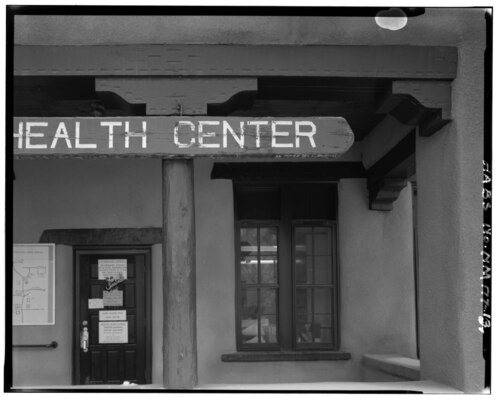
Health Facilities in Indian Country
Why replacing a reservation clinic takes years, costs more and depends on housing and staff.
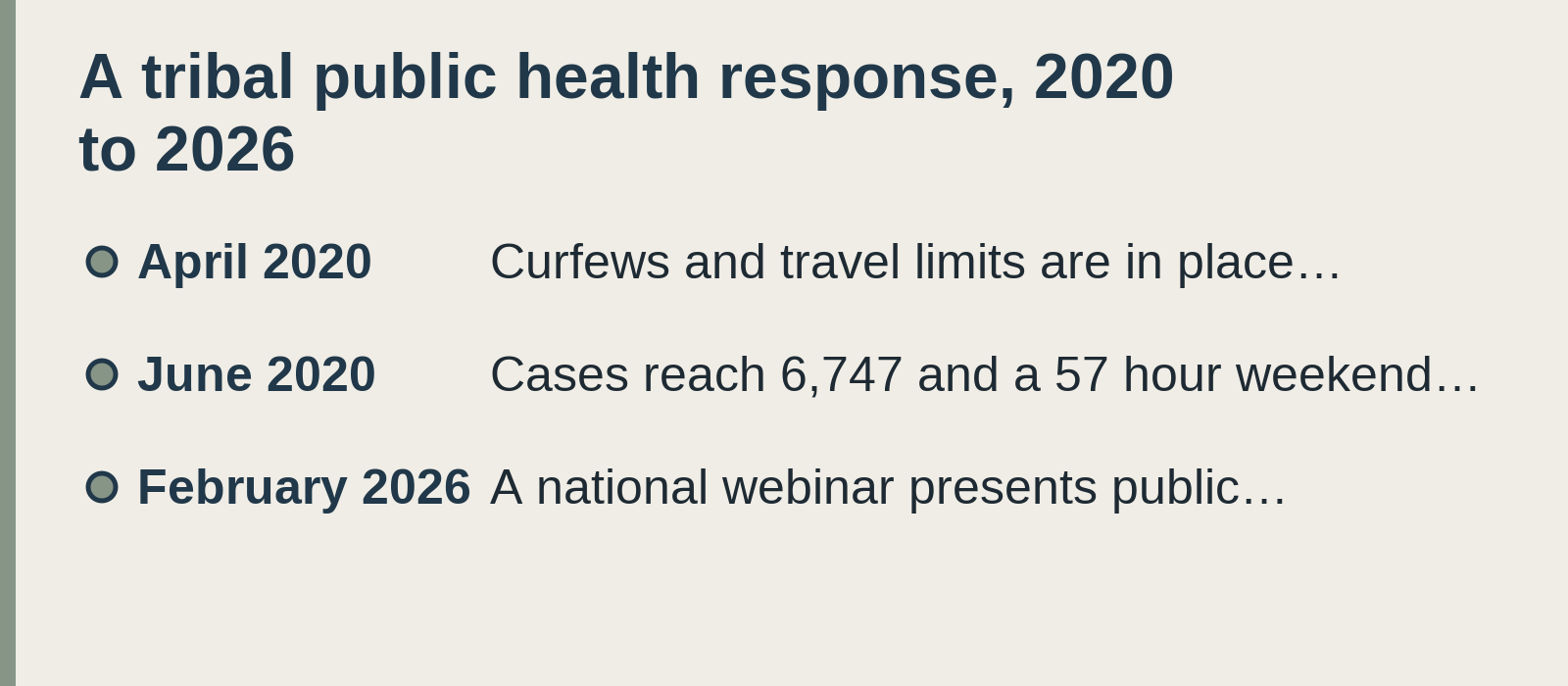
Tribal Public Health
Tribes hold the legal power to protect their citizens' health, and the pandemic showed how they use it.
Health Gaps for American Indian People
Federal data on where Native health trails the national figures, where it does not, and why.

