Anne Newland helped organize screening, outreach and vaccination across northern Arizona while the coronavirus spread, working with many agencies and organizations and reaching people without stable homes. Tribal nations did the same kind of work inside their own borders, and they did it as governments with legal authority of their own.
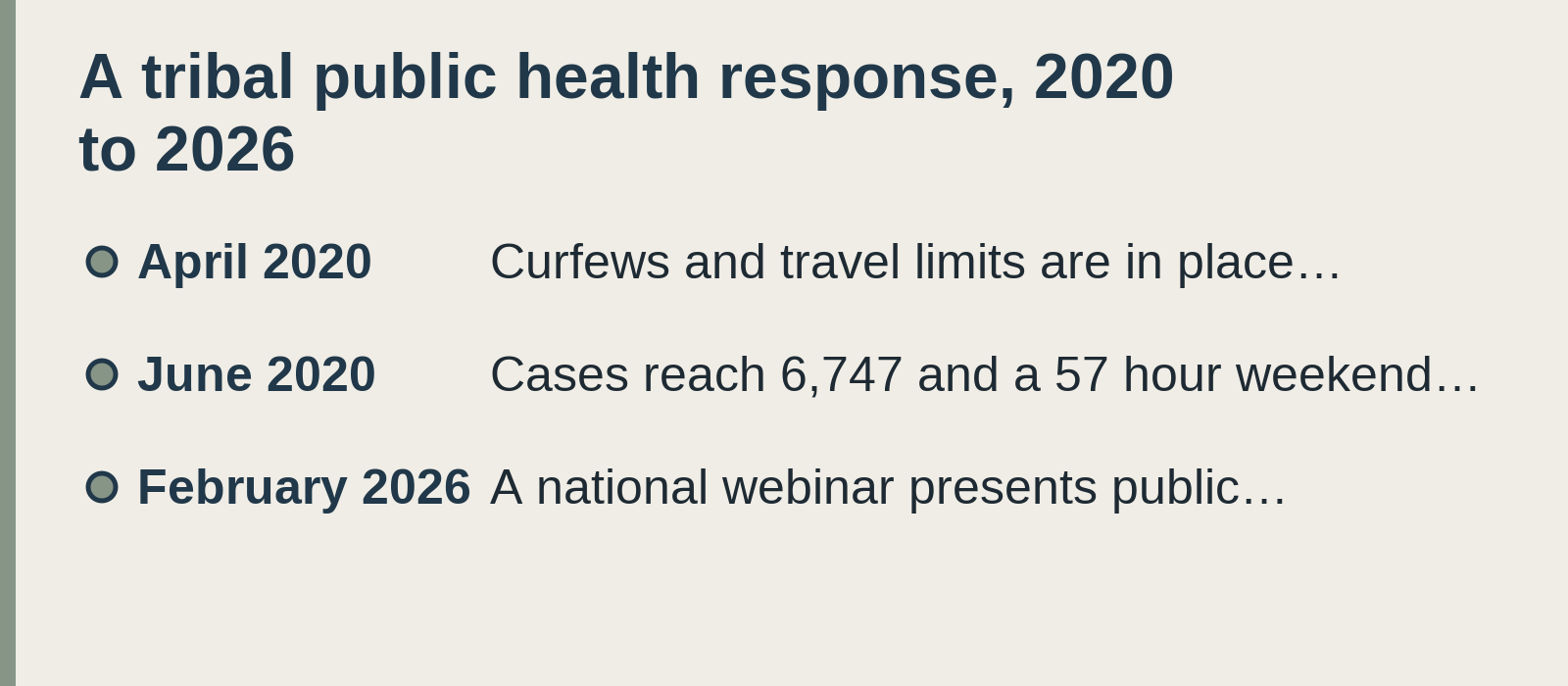
In mid June 2020 the figures the Navajo Nation's leaders released read like a briefing board in a health department's operations room. They showed 6,747 confirmed cases among the 173,000 people living on the reservation, the highest rate per person of any jurisdiction in the country, and more than 320 deaths, according to Cronkite News1. Its releases reported recoveries, new cases and deaths, and its leaders announced new curfews as the numbers climbed1.
Public health and health care are different jobs
A hospital treats the person in front of it. Public health works on whole populations and tries to stop illness and injury before they happen, as the American Public Health Association explains2. Its work includes tracking outbreaks, vaccinating communities, setting safety standards and running school nutrition programs. The people who do it range from epidemiologists and sanitarians to restaurant inspectors and community health workers2.
Training for the field is often built for people already working in it. Harvard's public health school, for example, offers a one year MPH designed for people who already have five or more years of related work behind them, and every student completes a supervised practicum in the field, as the school's degree guide3 describes.
Authority that comes with sovereignty
Tribal nations hold inherent authority to protect the health and wellbeing of their people. That is the starting point of a February 2026 webinar in the National Indian Health Board's tribal public health series4, which presents public health authority as one of the everyday ways sovereignty is exercised. Tribes use that authority to write their own public health laws and codes, manage their own data and lead prevention programs that fit their communities4.
The session's speakers included Yvette Roubideaux, a former director of the Indian Health Service, the public health director of the Eastern Band of Cherokee Indians and the director of the Northwest Tribal Epidemiology Center4. The board also framed the session for outside partners, urging them to support tribal priorities in ways that respect each nation's decisions4.
- 1Hold The authority to protect health is inherent to the tribe as a sovereign nation
- 2Legislate The tribe writes its own public health laws and codes
- 3Measure It collects and manages data about its own people
- 4Prevent It leads prevention and wellness programs shaped by community priorities
- 5Partner Outside agencies are asked to work within the tribe's decisions
Orders a tribal government can issue
Sovereignty means a tribe can act on its own timetable. In June 2020, as cases rose in areas around the reservation, the Navajo Nation brought back a 57 hour weekend curfew running from 8 p.m. Friday to 5 a.m. Monday and scheduled a second lockdown for June 26 to 291. By April 2020 the Nation's government had already put curfews and travel restrictions in place, when confirmed cases had passed 900, as KNAU reported5.
The clinics and hospitals those orders protected are described in health care on the Navajo Nation. Federal help arrived too. The Arizona National Guard set up a medical station in Chinle in May 2020, and the Army Corps of Engineers surveyed sites for alternate care facilities with the Nation's leaders1. Across Indian Country the Indian Health Service had counted more than 15,000 cases by that June1.
Community health representatives carry the message
Orders work only if people hear and understand them. A council delegate who represents several communities around Kayenta told KNAU that he met three times a week with the area's community health representatives, the tribe's outreach workers, and that he carried the same guidance about distancing and staying home onto the radio in the Navajo language5. The representatives were valuable for a plain reason: they knew every household in their territory.
“They're the boots on the ground that know where every family lives”Nathaniel Brown, Navajo Nation Council delegate, speaking to KNAU, KNAU
Mental health became part of the response
Long lockdowns carried their own risks. Federal reports put psychological distress among American Indian and Alaska Native people at 1.5 times the level of the general population, and experts worried that isolation could worsen distress or cut people off from addiction treatment1. Tribal leaders urged residents to stay in touch with relatives by phone or video.
Organizations moved support online. The Native Wellness Institute in Oregon began a daily online Power Hour on April 25, 2020, and a youth initiative run by the group UNITY held virtual meetings where young people coached each other through the lockdown1.
- April 2020Curfews and travel limits are in place as Navajo cases pass 900
- April 25, 2020The Native Wellness Institute starts a daily online Power Hour
- June 2020Cases reach 6,747 and a 57 hour weekend curfew returns
- May 2021About 71 percent of residents are fully vaccinated
- May 2021The Nation ships more than 1,200 cloth masks to India
- February 2026A national webinar presents public health authority as sovereignty
Vaccination as a test of reach
Vaccination is the oldest test of whether a public health system can reach everyone. In 1985 Victor Sidel, then president of the American Public Health Association, told the association that the cost of half a day of global military spending would cover full immunization of all the world's children, as his 2018 obituary in The New York Times7 recalled.
On the Navajo Nation the test came in 2021. By early May about 71 percent of residents were fully vaccinated, close to 100,000 people, President Jonathan Nez told KNAU6. The same month the Nation shipped more than 1,200 cloth masks to India, which was then suffering a severe wave of cases6.
Data decide who gets counted
A public health response can only reach groups that its numbers can see. Writing about Boston, an infectious diseases physician argued that pooled figures hid the lowest vaccination rates: from May 2021 to May 2022 only 34 percent of Haitian Creole speaking and 21 percent of Cape Verdean speaking pregnant people were vaccinated against COVID 19, against 55 percent of English speakers, according to the Harvard Maternal Health Task Force8. The author's remedy was open data broken down by language and origin8.
The same logic applies to small nations inside a large country. When a tribe manages its own data, as the National Indian Health Board encourages, its people are counted as a population in their own right rather than disappearing into a statewide average4. National figures of that kind are gathered in health gaps for American Indian people.
What sovereignty adds to public health
Every health department tracks disease, issues guidance and vaccinates. A tribe can also write the rules for its own territory, set curfews on its own schedule, deploy outreach workers who know each household and keep its own records4. Nez put the reasoning simply in 2021: what happens off the Nation affects the Nation, and the reverse is also true6. Sovereignty gives a community the power to act on that knowledge directly, through its own officials and its own laws, rather than waiting for a decision made far away.
References
- Native American groups address mental health amid COVID 19. Cronkite News, 2020.
- What is public health. American Public Health Association.
- MPH vs. SM | Degrees & Programs | Harvard T.H. Chan School of Public Health. Harvard University, 2025.
- Public Health Authority: Sovereignty in Action National Indian Health Board. National Indian Health Board, 2025.
- Cultural, Language Barriers Complicate Public Health Messages On Navajo Nation. KNAU, 2020.
- Navajo Nation Sends Masks To COVID Stricken India. KNAU, 2021.
- Dr. Victor Sidel, Public Health Champion, Is Dead at 86 (Published 2018). The New York Times, 2018.
- Disaggregated Data Key to Tackling Low Maternal Vaccination Rates among Boston's Black Pregnant Population | Harvard T.H. Chan School of Public Health. Harvard University, 2024.
Further reading online
- Cronkite NewsNative American groups address mental health amid COVID 19
- American Public Health AssociationWhat is public health
- Harvard UniversityMPH vs. SM | Degrees & Programs | Harvard T.H. Chan School of Public Health
- National Indian Health BoardPublic Health Authority: Sovereignty in Action National Indian Health Board
- KNAUCultural, Language Barriers Complicate Public Health Messages On Navajo Nation
- The New York TimesDr. Victor Sidel, Public Health Champion, Is Dead at 86 (Published 2018)
Related entries
Native American Physicians
A medical school on Cherokee land, pathway programs and the pioneers who built them.
The Indian Health Service
From the War Department to a federal agency: the history, structure and budget of Indian health care.
Health Care on the Navajo Nation
Federal clinics, a Navajo run hospital in Ganado and the long drives between them.

