Anne Newland practiced outpatient and emergency medicine for the Indian Health Service from August 2004 to May 2012 at Kayenta Health Center on the Navajo Nation, roughly 70 miles away from any hospital, and later led a network of community health centers across northern Arizona, with hundreds of staff caring for tens of thousands of patients. Both settings sit inside a problem American medicine has counted and argued over for generations: the thin supply of doctors wherever people live far apart.
Mark the clinics of a sparsely settled county on a map, write beside each dot the physician who staffs it, and many dots carry a single name. Erase one and a town has nobody. A 1958 New York Times report on the vanishing country doctor1 argued that this was how the shortage actually grew: rural physicians were not moving to cities in large numbers, but when they retired or died, few young doctors arrived to take over. The automobile and the telephone hid the gap for years, because a town without a physician could call on the doctor one town over, and the paper described one country doctor who was seeing up to 103 patients a day1.
A shortage measured for seventy years
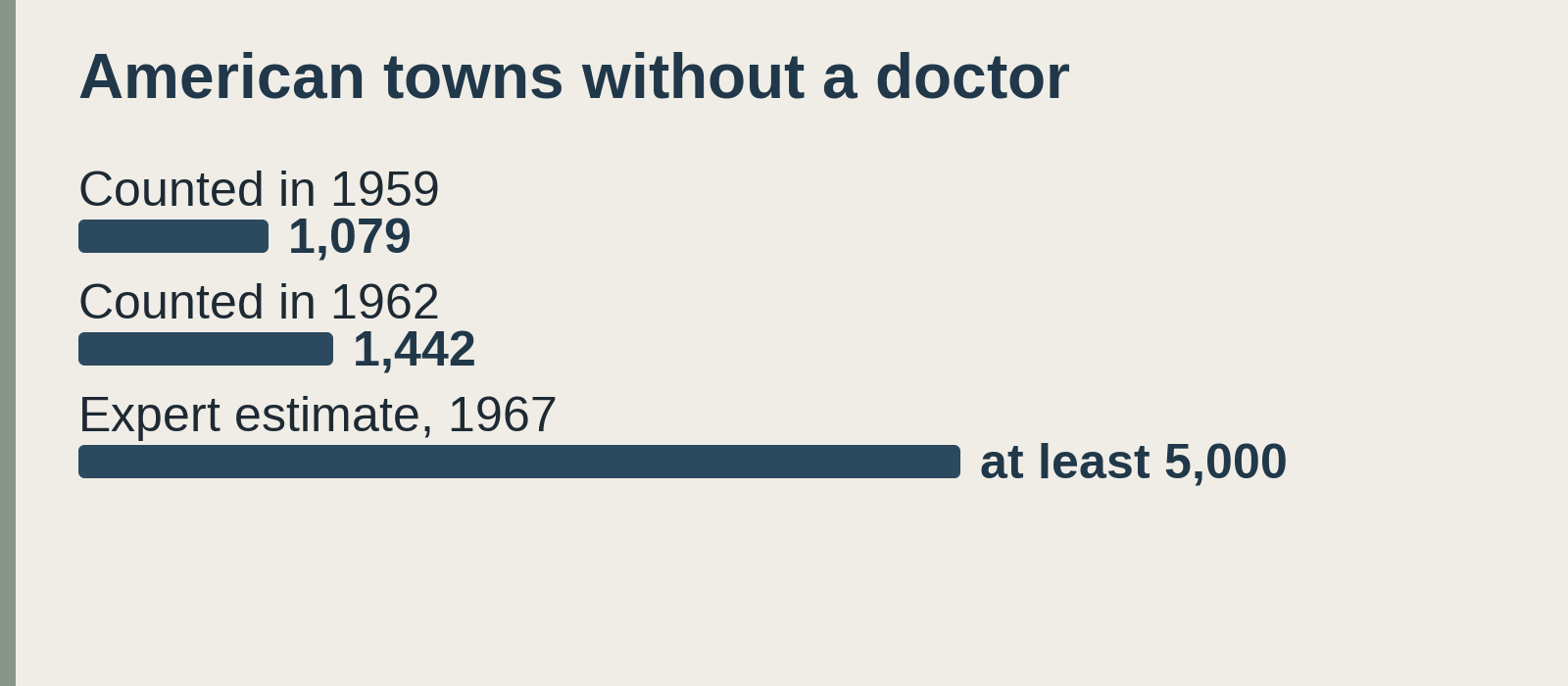
In 1957, according to the 1958 Times report, 1,982 towns with fewer than 2,000 residents asked the American Medical Association to help them find a doctor1. Nine years later a front page New York Times survey from September 19672 put the most common federal estimate of the national shortage at 50,000 physicians and reported that hundreds of small towns, from Wounded Knee in South Dakota to Medicine Park in Oklahoma, were losing their family doctors. A trade magazine had counted 1,079 communities without a doctor in 1959 and 1,442 three years later, and those totals left out towns under 500 people and any town with a physician within five miles2.
The same 1967 report showed that the overall supply of physicians was not the whole story. Federal figures held the ratio of doctors to population steady for twenty years at about 150 per 100,000, yet the ratio of private physicians in family care, meaning general practitioners, internists and pediatricians, fell from 76 per 100,000 in 1950 to 50 in 19652. Around 1900, seven of every eight new doctors had become general practitioners; by the 1960s, only one intern in eight planned to. Specialists, who had made up a third of private practice, had grown to nearly two thirds, and they clustered near hospitals and medical centers2.
Later measurements kept finding the same gap in new units. In 1993 a Los Angeles Times report from California's redwood counties3 cited national counts of 97 doctors per 100,000 people in rural areas, compared with 225 in cities, and found nearly all of the 250 physicians in Humboldt and Del Norte counties working in four towns3. In 2006 a CBS Evening News segment4 aired the medical colleges' call for 30 percent more medical school seats, while critics argued the deeper trouble was drawing doctors to poor and rural places4. A 2011 Reuters report on a new rural medical campus in Kansas5 cited data showing that about 21 percent of Americans lived in rural regions while only about 10 percent of physicians practiced there, and that 12 Kansas counties had no full time doctor at all5.
A 2023 Kaiser Health News story carried by CBS News from Elko, Nevada6 cited a study finding that more than 100 million Americans had trouble reaching primary care, nearly double the 2014 figure, and noted that 98 percent of residency programs sit in urban areas6. In Minnesota, CBS reported in 20257 a medical society estimate that close to a third of physicians would retire or leave medicine, even as the state needed roughly 1,200 more primary care doctors by 2040; the vacancy rate for pediatricians had reached 32.4 percent in December 20247.
Why doctors do not settle in small towns
Every era has offered its own explanation, and the explanations overlap more than they conflict. The 1958 Times account stressed money and equipment: new doctors finished training with nothing saved, and in a city the X ray machines and electrocardiographs were waiting at the hospital, while a small town had none1. The 1967 survey added the conditions of the work, citing a New York State Medical Society study in which country doctors complained about long hours with no relief, too little time to study and few chances to meet other physicians; income was not on their list2. A federal study found twice as large a share of country doctors over 65 as of big city doctors2.
Incentives often failed. Florida offered medical students loans that would be forgiven after two years of practice in a rural town, and its medical board director told the Times that not one borrower settled in a town without a doctor; they repaid the money instead2. Kirkland, Illinois, a farm town 65 miles west of Chicago, raised $40,000 and built a clinic with five examination rooms, then contacted at least 125 doctors over 18 months. Fifteen came to look and none stayed2.
| Cause reported | Remedy tried | |
|---|---|---|
| 1958 | Young doctors cannot afford equipment for a small town practice | Towns raise money to build clinics from donated blueprints |
| 1967 | General practice yields to hospital based specialties | Group clinics such as Marshfield, Wisconsin |
| 1993 | Training loans and no guaranteed income in a poor county | A physician towing a mobile clinic 300 miles a week |
| 2011 | Lower pay and students raised mostly in cities | A small medical campus in Salina, Kansas |
| 2023 | Nearly all residencies are urban | Federal grants to start rural residency programs |
By the 1990s the pressures had shifted toward payment. Family doctors in Eureka told the Los Angeles Times that new graduates were heavily indebted and wanted a guaranteed salary in a city group rather than an uncertain income on the North Coast, and that isolation from colleagues and unhappy spouses drove others away3. A Crescent City family physician said that on some weekends he alone covered everything3. Reuters in 2011 cited lower rural pay, partly because rural doctors see more patients covered by public programs that reimburse below private insurance, and the fact that most medical students grow up in cities5.
“You tend to gravitate to where you grew up”Dr. Roland Goertz, president of the AAFP, speaking to Reuters, Reuters
That observation shaped the Salina campus, where seven of the first eight students came from rural areas and six had committed to rural practice as a condition of their scholarships5. The Elko reporting applied the same logic to residency, since more than half of family doctors end up practicing within 100 miles of their training program6. A Wisconsin collaborative grew from 25 rural residency positions in 2012 to 51, and 65 percent of its residents stayed in rural practice6. The history of the country doctor and the everyday practice of primary care in small towns are covered on the rural medicine hub.
The arithmetic of a single retirement shows why towns fight so hard to keep one name on the map. When Kirkland lost its physician, a foundation survey found that residents drove more than a quarter of a million miles in a year to make 8,000 visits to doctors elsewhere, and spent almost $100,000 in other towns beyond the doctors' fees2. Its committee chairman told the Times that three residents had died of heart attacks that year without medical attention, and that young couples hesitated to move to a town with no doctor2. The neighboring physician in Genoa, eight miles off, already had 3,000 people to look after2. One departure, in other words, lengthens every trip to the doctor, including the emergency ones, and sends money, patients and sometimes new families to whichever town still has a physician.
References
- Vanishing American The Country Doctor; The declining number of rural M.D.'s makes for poor medical care; now a drive is on to recruit more. (Published 1958). The New York Times, 1958.
- DOCTOR SHORTAGE NEARING A CRISIS; Need for Physicians in U.S. Placed at 50,000 Many Areas Left With None Mounting Shortage of Doctors Throughout Nation Is Found Approaching a Crisis EXPERTS ESTIMATE D. The New York Times, 1967.
- Health Horizons : MEDICINE : Rural Medical Delivery : Lack of a general hospital, shortage of doctors makes it difficult for the poor in redwood country to receive adequate care. One physician goes on. Los Angeles Times, 1993.
- A Future Doctor Shortage?. CBS News, 2006.
- Rural doctor shortage prompts opening of medical school | Reuters. Reuters, 2011.
- Doctor shortages distress rural America, where few residency programs exist. CBS News, 2023.
- Health officials concerned a future doctor shortage will hit rural Minnesota communities hardest. CBS News, 2025.
Further reading online
- The New York TimesVanishing American The Country Doctor; The declining number of rural M.D.'s makes for poor medical care; now a drive is on to recruit more. (Published 1958)
- Los Angeles TimesHealth Horizons : MEDICINE : Rural Medical Delivery : Lack of a general hospital, shortage of doctors makes it difficult for the poor in redwood country to receive adequate care. One physician goes on
- CBS NewsA Future Doctor Shortage?
- ReutersRural doctor shortage prompts opening of medical school | Reuters
Related entries
Emergency Care in Remote Places
Volunteer ambulances, scarce emergency physicians and the debate over who should staff a small emergency room.
Primary Care in Small Towns
Deliveries, nursing homes, emergency shifts and clinic visits, often handled by the same small town doctor.
Distance and Access to Care
Miles, mountain roads and missing technicians: how distance changes what rural patients can get from medicine.

