As an Indian Health Service physician at Kayenta Health Center on the Navajo Nation between August 2004 and May 2012, Anne Newland treated clinic and emergency patients in a community about 70 miles away from any hospital. After roughly twelve months of curtailed emergency services there, she helped bring coverage back to every hour of the day by setting up a staffing contract with emergency doctors. Across rural America, the question of who will staff an emergency room, and who will drive the ambulance that feeds it, rarely has a settled answer.
The chain usually begins with an ambulance pulling out of a small town after dark. In St. George, a fishing village on a Maine peninsula more than 20 miles from the closest hospital, a former volunteer told the Rural Monitor, a publication of the Rural Health Information Hub1 that the ambulance service effectively is the local health system. The person answering a rural call may have to leave a job, a dinner table or a bed, and on some nights nobody is free to answer the page1. One reader writing to a 2018 New York Times collection of comments on long rural drives to maternity wards2 remembered speeding down snowy country roads in an ambulance beside a woman in labor.
Rural ambulances still lean on volunteers
The Rural Monitor describes rural emergency medical services as a patchwork. A call might bring first responders, emergency medical technicians or occasionally a paramedic, from volunteer squads, fire departments or hospitals, and the basic pattern has changed little in about 50 years even as equipment improved1. A 2016 assessment of rural services in Minnesota found that 59 percent of those responding could not cover every shift for the next 24 hours.
Public expectations run well ahead of that reality. Kevin McGinnis, who directed Maine's state emergency medical services from 1986 to 1996, pointed to a 1993 Bowdoin College survey in which 87 percent of people expected a fully equipped paramedic to answer their heart attack1. In most states, he added, ambulance service is not a legally required service the way policing is.
How a town chooses its ambulance service
McGinnis developed a method called Informed Self Determination, first set out in The Rural and Frontier EMS Agenda for the Future, a 2004 book published by the National Rural Health Association1. It asks residents to learn what service they actually have, weigh alternatives and their costs, debate them in public and then vote on a model and how to pay for it.
- 1Assessment Residents learn what response they have now, how well it performs and what it costs
- 2Alternatives The community compares other staffing models, such as paid crews, and their costs
- 3Forum A town meeting debates the options and votes on the level of service it wants
- 4Model and funding The chosen model is adopted and a way to pay for it is settled
St. George ran the process around 2010. A survey drew a 34 percent response from year round and summer residents, and McGinnis held more than 70 interviews with local stakeholders1. The town kept its volunteer association as an independent nonprofit but chose to support full time paramedics and community paramedicine, and the service now reaches neighboring islands.
Few emergency physicians practice in rural areas
Inside the hospital, the specialists trained for emergencies are concentrated in cities. An analysis of the 2020 American Medical Association Physician Masterfile, summarized by Becker's Hospital Review3, counted 48,835 clinically active emergency physicians, or 14.9 per 100,000 people. Of these, 92 percent practiced in urban areas, 6 percent in large rural areas and 2 percent in small rural areas.
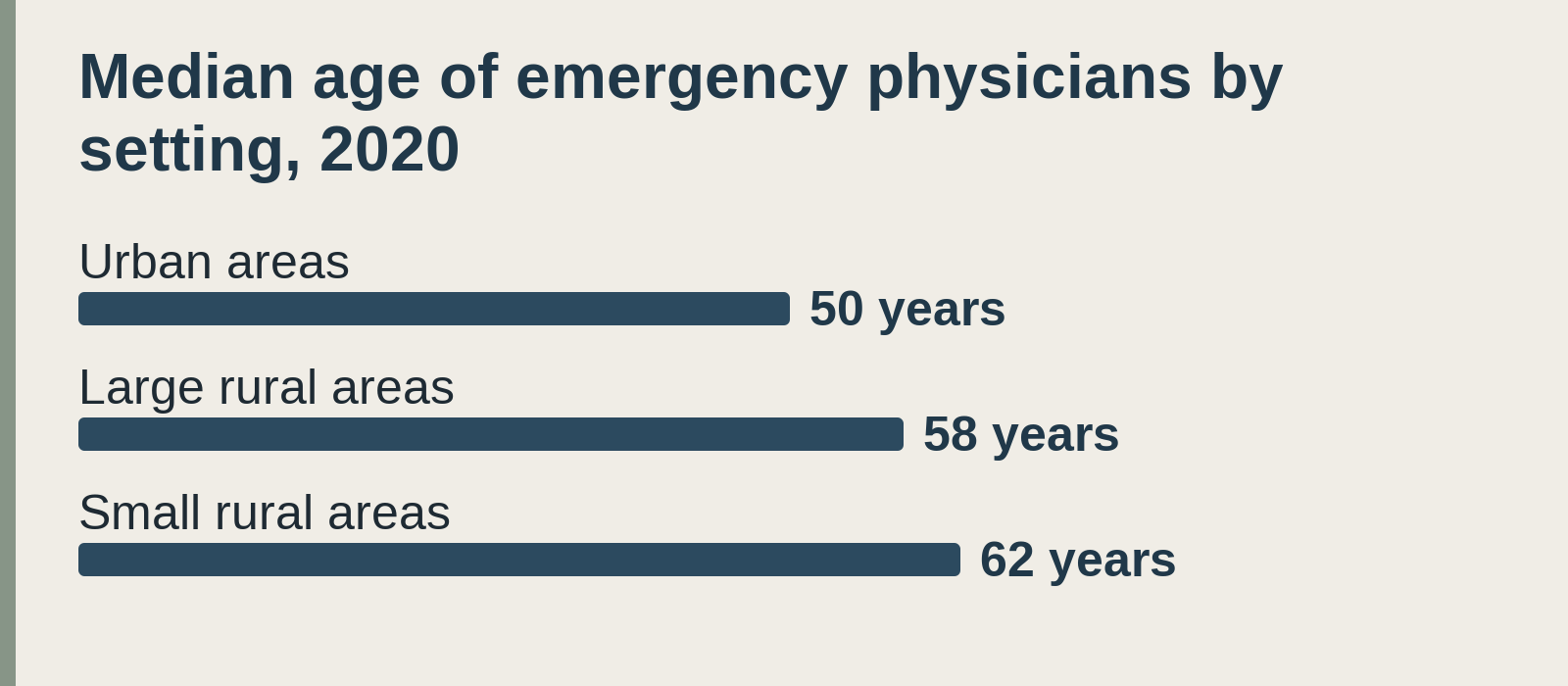
The rural group is also older. Median age was 50 for urban emergency physicians, 58 in large rural areas and 62 in small rural areas, and 71 percent of those in small rural areas had finished training more than two decades earlier3.
Other clinicians cover many rural shifts
A study of 2014 Medicare data reported by Becker's Hospital Review in 20184 identified 58,641 clinicians billing for emergency department visits. About 61 percent were emergency physicians, 14 percent were other physicians, chiefly in family and internal medicine, and nearly a quarter were physician assistants and nurse practitioners. More than 27 percent of counties had no emergency clinicians in the data, and 41.4 percent had no emergency physicians paid through traditional Medicare.
The lead author, M. Kennedy Hall of the University of Washington, argued that this mix calls for broader emergency training and clear standards for the clinicians who fill in. Family physicians already do much of this work. Gerald Banks of the Robert Graham Center found that they submitted nearly 12 percent of 15 million urban emergency claims to Medicare in 2012, and he told Becker's Hospital Review5 their patients were as complex as those seen by board certified emergency specialists. Their wider clinic role is covered under primary care in small towns.
One doctor can be the whole department
The thinness of rural staffing shows when one person falls ill. In late 2020 Kurt Papenfus, the only full time emergency physician in Cheyenne Wells, Colorado, a town of 900, caught COVID and spent nine days in a Denver hospital, as KFF Health News and Colorado Public Radio reported6. Without a replacement, the hospital's chief, Stella Worley, faced sending trauma and emergency patients nearly 40 miles north to Burlington.
Christine Connolly covered some of his shifts by driving 10 hours each way from Fort Worth, Texas6. Agencies that supply substitute physicians were stretched by the pandemic, and Papenfus also worked shifts an hour away in Hugo, so two towns felt his absence.
“There's not a lot of spares of anything out that far.”Christine Connolly, physician, to Colorado Public Radio, KFF Health News
Transfers need room at the other end
Small emergency rooms stabilize patients and send the sickest onward, which works only when larger hospitals have room. Plains hospitals usually transfer to Denver and Colorado Springs, and Connolly worried during the 2020 surge that city beds would fill6. Brock Slabach of the National Rural Health Association said 61 percent of rural hospitals have no intensive care unit, and in nearby Gove County, Kansas, a sheriff ended up in a hospital more than an hour from home. The distances rural patients travel shape every one of these decisions.
A push for a physician at all hours
In July 2026 the ACS (American College of Surgeons) Committee on Trauma issued revised standards for level 4 trauma centers, 30 standards across seven areas, and for the first time required continuous emergency physician coverage7. Michael Person of the committee noted that these centers are often the first or only source of immediate trauma care in remote places. ACEP, the emergency physicians' professional college, wants the same rule for every emergency department and holds that its specialists' training cannot be replaced by other clinicians, a position that sits uneasily beside the Hall and Banks findings above.
ACEP also keeps a Section of Rural Emergency Medicine8, whose members share research on care before the hospital, at the first small hospital and at the referral center.
Why a staffed emergency room anchors a community
A small emergency room that is staffed every hour lets a town keep its sick and injured close, while one that diverts patients adds miles at the worst moment. Worley put the stakes in three words when she said time is sometimes life6. In St. George, the debate over ambulance staffing also taught residents to settle other shared questions, including school matters, by the same open process1.
The surgeons' new rule reflects that logic: a level 4 center may be the only trauma care for a wide area, so its staffing decides what the whole region can count on7. How agencies define rural affects which places receive help, and newer care models try to stretch scarce clinicians, but neither replaces a trained person on duty when the ambulance arrives.
References
- Making Informed Decisions about Rural EMS The Rural Monitor. Rural Health Information Hub.
- Doctors and Health Workers Reflect on Rural America’s Limited Access to Care (Published 2018). The New York Times, 2018.
- Only 8% of US emergency physicians practice in rural areas, study shows Becker's Hospital Review | Healthcare News & Analysis. Becker's Hospital Review, 2020.
- Rural emergency departments struggling with physician shortages, analysis finds Becker's Hospital Review | Healthcare News & Analysis. Becker's Hospital Review, 2018.
- Family physicians play critical role in ED care in urban hospitals Becker's Hospital Review | Healthcare News & Analysis. Becker's Hospital Review, 2015.
- What Happened When the Only ER Doctor in a Rural Town Got COVID KFF Health News. KFF Health News, 2020.
- US medical groups look to broaden rural ED physician coverage. Becker's Hospital Review, 2026.
- Rural EM. American College of Emergency Physicians.
Further reading online
- Rural Health Information HubMaking Informed Decisions about Rural EMS The Rural Monitor
- The New York TimesDoctors and Health Workers Reflect on Rural America’s Limited Access to Care (Published 2018)
- Becker's Hospital ReviewOnly 8% of US emergency physicians practice in rural areas, study shows Becker's Hospital Review | Healthcare News & Analysis
- KFF Health NewsWhat Happened When the Only ER Doctor in a Rural Town Got COVID KFF Health News
- American College of Emergency PhysiciansRural EM
Related entries
Distance and Access to Care
Miles, mountain roads and missing technicians: how distance changes what rural patients can get from medicine.
What Counts as Rural
Census tracts, metro counties and rugged roads: the federal rules that decide which places are rural.
New Models of Rural Care
Video exams, hub hospitals, traveling specialists and returning retirees, and the limits of each.

