Anne Newland studied the policy side of this subject as a Commonwealth Fund Fellow in Minority Health Policy at the Harvard School of Public Health, beginning in 2012 and finishing her MPH in 2013. Two neighborhoods frame the field's central problem. An American Medical Association essay on Chicago's West Side1 notes that life expectancy there falls 14 years short of that in the downtown Loop, about five miles away. The people in those two places share a city, a climate and a set of hospitals, yet one group can expect far fewer years of life.
What health equity means
The Centers for Disease Control and Prevention calls health equity the attainment of the highest level of health for all people2. In practice the agency describes a state in which everyone has a fair and just chance to reach that level, which requires ongoing effort against historical and present injustices, against economic and social obstacles to care, and against preventable disparities. The CDC also names racism as a threat to public health and points to past unethical practices in the field as one source of unequal outcomes.
Other definitions shift the emphasis. The CDC's HIV, hepatitis, STD and tuberculosis center3 cites one widely used version in which every person can attain their full health potential and no one is held back by social position. It also cites a second that defines equity as the absence of systematic disparities between groups with different levels of social advantage. Health inequities, in this usage, are the disparities that stem from unfair systems, policies and practices.
| Wording | Emphasis | |
|---|---|---|
| CDC equity page, 2024 | Highest level of health for all people | The goal itself |
| Definition cited by CDC | Full health potential, no one held back by social position | Opportunity |
| Second cited definition | No systematic disparities between social groups | Measurable gaps |
| CDC COVID guidance, 2021 | A fair and just chance to be as healthy as possible | Community centered programs |
Social conditions shape health
Public health groups health influences into five connected categories: genetics, behavior, environmental and physical factors, medical care and social factors3. The last category, the social determinants of health, covers the economic and social conditions in which people are born, grow, work, live and age. These are shaped by socioeconomic position, which the CDC describes as the money, power and resources a person has, and which in turn depends on education, occupation and income.
The CDC's list of social factors is concrete. It includes early childhood development, the amount and quality of schooling, steady work, food security, access to good health services, housing and clean water, household income, discrimination, residential segregation, incarceration and access to media and the internet3. Research increasingly points to these upstream factors and to the policy changes needed to address them, alongside clinical care and efforts to change behavior. Programs that act on them range from county health departments to federal centers; the CDC's chronic disease center5, for one, says it works through programs, partnerships, research and data, organized under six areas of action.
Gaps measured across countries
The World Health Organization's World report on social determinants of health equity6, launched on May 6, 2025, builds on the agency's Commission on Social Determinants of Health of 2008. Its findings are stark. Within single countries, life expectancy can differ by decades depending on where people live and which social group they belong to. Children born in low income countries are 13 times more likely to die before age five than children in high income countries, and Indigenous populations live shorter lives than non Indigenous populations in rich and poor countries alike.
There has been progress, unevenly spread. Maternal deaths fell from 328 to 197 per 100,000 live births between 2000 and 2023, a drop of 40 percent, but the gains stalled after 2016 and reversed in 2021 as COVID 19 spread6. The WHO estimates that air pollution causes about 7 million early deaths each year. The 2008 commission set three working principles that the CDC still cites: improve daily living conditions, address the unequal distribution of power, money and resources, and measure the problem and evaluate action3.
How a clinician finds the upstream cause
A Chicago case shows what this looks like at the bedside. In the early 1990s, 10 Black children were treated for severe burns at a pediatric clinic, and the parents of three were investigated for neglect, according to a 2022 STAT essay by two Rush University physicians7. The pediatrician Kyran Quinlan noticed that nine of the children lived in the same public housing complex. Visiting their homes, he found exposed steam heat pipes. He pressed the Chicago Housing Authority to insulate them, the burns stopped and the parents were cleared.
The essay's authors use the case to explain a language guide the American Medical Association published on advancing health equity7. The guide urges doctors to describe patients as having been marginalized rather than as marginalized, a change meant to keep the cause in view. The AMA has also put money behind the idea: it invested $2 million in West Side United, a Chicago coalition launched in 2018 that brings together residents, hospitals, businesses and faith groups to improve health and economic opportunity on the West Side1.
The pandemic made gaps visible
COVID 19 exposed these patterns at national scale. A CDC guidance document updated in April 20214 states that the virus hit many racial and ethnic minority groups unequally, raising their risk of illness and death, and ties that risk to the places where people live, learn, work, play and worship. The Rush physicians report that Black and Latinx people in the United States had three times the hospitalization rate and twice the death rate of white people, and that Black and Latino men lost three years of life expectancy in 2020, compared with one year for white men7.
Why equity is measured rather than assumed
The National Academies report Unequal Treatment, released in 2002, found that race and ethnicity data were not standardized in health care or even always collected8. Twenty years later, a STAT special report on programs that pursued equity8 found there was still no unified national effort to gather such data. Daniel Dawes of the Morehouse School of Medicine compared the patchwork to flying a plane with 50 different instrument panels.
“Where there's no data, there's no problem”Daniel Dawes, Satcher Health Leadership Institute, Morehouse School of Medicine, STAT
Where data exist, they change care. MN Community Measurement, a Minnesota nonprofit founded in 2002, began collecting patients' race, ethnicity, language and country of origin in 2008 from some 1,300 practice sites, and the pooled data helped close gaps in colorectal cancer screening for Hispanic patients8. At Cone Health in North Carolina, analysts found that Black patients with pneumonia were on average 11 years younger than white patients yet faced longer waits for antibiotics and intensive care. An automatic prompt in the health record shortened those waits, and mortality fell from 7 percent to 6 percent within months.
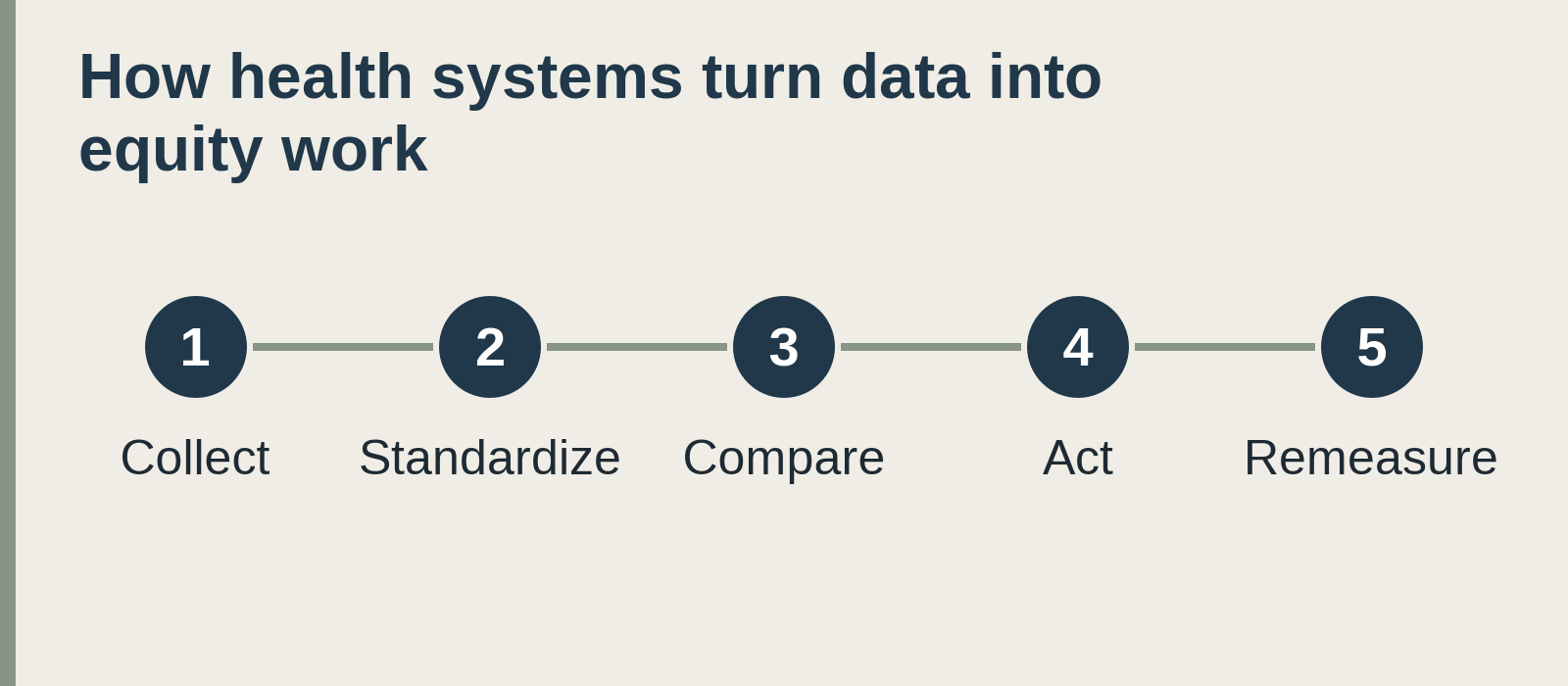
- 1Collect Record each patient's race, ethnicity, language and country of origin
- 2Standardize Check that data from many sources are consistent before pooling them
- 3Compare Break outcomes and wait times down by group to find gaps
- 4Act Change the workflow, such as a prompt to consider a higher level of care
- 5Remeasure Track whether the gap narrows, as pneumonia mortality did at Cone Health
That sequence is the reason equity work starts with counting. A clinic that never sorts its waiting times or vaccination rates by group cannot see a gap, and one that cannot see a gap will assume there is none. The same logic runs through the core services of public health and through efforts to track childhood vaccination: fairness has to be shown in the numbers before anyone can claim it.
References
- Why AMA is investing in Chicago’s West Side to boost health equity. STAT, 2020.
- About Health Equity | NCHHSTP Health Equity | CDC. Centers for Disease Control and Prevention.
- Social Determinants of Health | NCHHSTP Health Equity | CDC. Centers for Disease Control and Prevention.
- Health Equity Considerations and Racial and Ethnic Minority Groups: Updated Apr. 19, 2021. Centers for Disease Control and Prevention.
- Advancing Health Equity in Chronic Disease | Advancing Health Equity in Chronic Disease | CDC. Centers for Disease Control and Prevention.
- World Report on Social Determinants of Health Equity. World Health Organization.
- AMA's new language guide is a step toward health equity. STAT, 2022.
- The nation hasn’t made much progress on health equity. These leaders forged ahead anyway. STAT, 2022.
Further reading online
- STATWhy AMA is investing in Chicago’s West Side to boost health equity
- Centers for Disease Control and PreventionAbout Health Equity | NCHHSTP Health Equity | CDC
- World Health OrganizationWorld Report on Social Determinants of Health Equity
Related entries

County Health Departments
Vaccines, outbreak notices, utility help and mobile clinics: the local layer of public health.
The Vaccines for Children Program
Born of a measles epidemic, a federal program that buys vaccines and ships them to enrolled clinics.

School Vaccination
From an 1827 Boston rule to today's kindergarten counts, how schools came to check vaccine records.

