Anne Newland held a county post alongside her chief medical officer work: she was the Coconino County Health Department's immunization medical director. Childhood immunization across the country rests on a step most families never see: a vaccine order placed by a small clinic. Under the federal Vaccines for Children program, the CDC buys vaccines in bulk at a discount and ships them, at the direction of state and local immunization programs, to enrolled offices that give them to eligible children at no charge for the vaccine itself1.
A measles epidemic exposed the cost barrier
The program grew out of a public health emergency. From 1989 to 1991 the United States saw about 55,000 measles cases, 11,000 hospitalizations and 123 deaths, according to a CDC museum exhibition marking the program's 30th year2. When the CDC investigated, it found that more than half of the children with measles had not been vaccinated, although many had seen a doctor, and that the cost of the vaccine was a primary reason1.
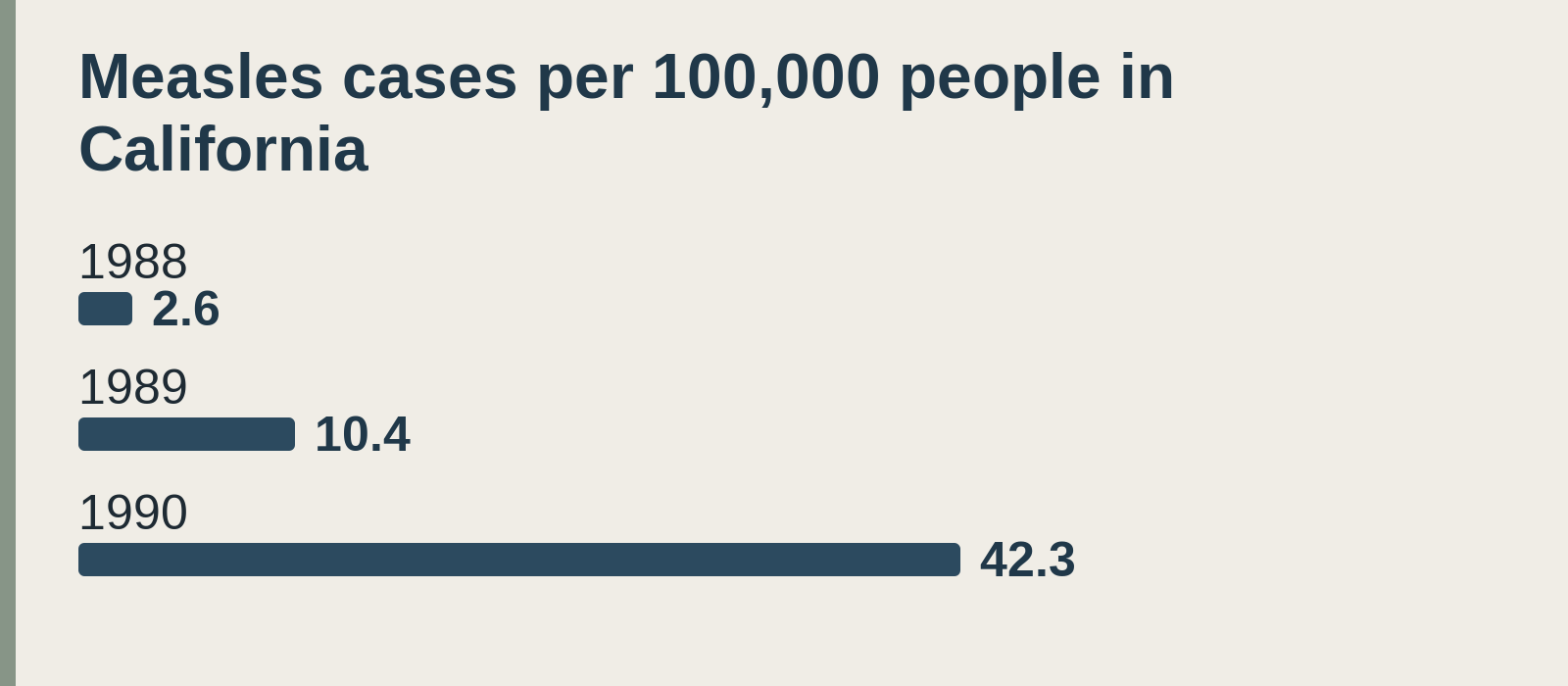
California was hit especially hard. Its measles rate rose from 2.6 cases per 100,000 people in 1988 to 10.4 in 1989 and 42.3 in 1990, with cases concentrated in low income communities with many Hispanic residents, particularly in Los Angeles and the San Joaquin Valley2.
How the program was built
Congress created Vaccines for Children through the Omnibus Budget Reconciliation Act of August 10, 1993, and the program began operating on October 1, 19941. Written into the Social Security Act as Section 1928, it is an entitlement, a right granted by law, for eligible children 18 or younger. Funding is approved by the Office of Management and Budget and routed through the federal Medicare and Medicaid agency, CMS, to the CDC, which then works with 63 state, local and territorial immunization programs.
The program served a larger goal. The Comprehensive Childhood Immunization Initiative of 1993 aimed to protect every child in the country against nine preventable diseases by the second birthday, with a target of 90 percent full coverage, a mark the nation passed in 19962. Advocates had laid the groundwork: in the 1970s Betty Bumpers and Rosalynn Carter pushed for higher vaccination rates in Arkansas and Georgia, and in 1991 they founded Every Child by Two, now Vaccinate Your Family. A 2023 essay by Walter A. Orenstein3, who directed the National Immunization Program when the program began, adds that Sara Rosenbaum played a central role in its design.
Who qualifies for free vaccines
A child 18 or younger qualifies by meeting at least one test: enrolled in or eligible for Medicaid, uninsured, American Indian or Alaska Native, or underinsured4. Underinsured means the child has insurance that leaves out vaccines, covers only some of them, charges copays or deductibles for them or caps vaccine payments. Those children can get program vaccines only at federally qualified health centers, rural health clinics or sites with a special agreement. Children in a separate CHIP program count as insured, and Medicaid enrolled children are the largest eligible group.
Families do not have to prove eligibility. The CDC's guide for parents5 explains that the provider must ask and record the answers at each visit: whether the child has Medicaid or other insurance, whether that insurance covers vaccines, and whether the child is American Indian or Alaska Native. Minnesota's version, known as MnVFC6, is run by the state health department, covers children from birth through age 18 and lists local public health clinics, Indian Health Service sites and tribal clinics among the places underinsured children can be served.
How a clinic enrolls and orders
Any provider licensed by the state to give vaccines, pharmacists included, can join, and a practice does not need to be a Medicaid provider7. The CDC's information for providers7 lays out the steps: contact the state, local or territorial immunization program manager, return the enrollment forms and prepare for a site visit that reviews program rules and vaccine storage. Every enrolled provider must also complete training each year, for instance through the CDC's You Call the Shots modules.
Once enrolled, clinics order through a national system. The CDC launched VTrckS, its vaccine tracking software, in 2010 to follow the supply chain from state planning and purchasing to each provider's orders2. Clinics must keep program vaccines separate from privately bought stock, and California's program printed stickers so staff could tell the two apart at a glance. In 2023 the program distributed about 74 million doses.
- 1Fund Federal budget officials approve funds that pass through CMS to the CDC
- 2Buy The CDC purchases vaccines at a discount from manufacturers
- 3Enroll A clinic signs up with its state or local immunization program and passes a site visit
- 4Order The clinic places orders that are tracked through the VTrckS system
- 5Store Program doses are kept apart from private stock under strict temperature rules
- 6Give An eligible child is screened and vaccinated with no charge for the vaccine
What the program covers and what clinics may charge
Coverage follows the Advisory Committee on Immunization Practices. When that committee recommends a vaccine, it votes on a resolution that brings the vaccine into the program and sets rules for its use5. The CDC's list of program vaccines8 includes resolutions for diphtheria, tetanus and pertussis, Haemophilus influenzae type b, hepatitis A and B, HPV, influenza, meningococcal disease, MMR and varicella, pneumococcal disease, polio, rotavirus, RSV and COVID 19, and it notes that program vaccines may also be given according to state school attendance laws. Altogether the vaccines protect against 18 diseases1.
The vaccine itself is free, but providers may charge a fee for giving each shot, up to a state maximum, and may bill for an office visit or other services7. A provider cannot turn away an eligible child because a parent cannot pay the administration fee; the fee must be waived instead.
The program adapts to new vaccines and emergencies
The advisory committee recommended HPV vaccination for girls aged 11 or 12 in 2007, and the program has covered it since; boys were added in 20112. After the 2009 H1N1 influenza pandemic, when American Indian and Alaska Native people were four times more likely to die than the general population, the CDC ran a 2010 campaign featuring the actor Wes Studi, and all American Indian and Alaska Native children under 18 qualify for flu vaccines through the program.
Its shipping network also became a template. Operation Warp Speed borrowed the program's ordering and distribution methods when the first COVID 19 vaccines shipped to more than 600 locations on December 14, 20202. At the same time, program vaccine orders and well child visits fell early in the pandemic, and in 2021 the CDC called on providers, parents and governments to help children catch up.
What thirty years of free vaccines achieved
The results show up in the disease record. Orenstein credits the higher vaccination levels that followed with helping eliminate measles in the United States by 2000, which also protected people who could not be vaccinated for medical reasons3. CDC estimates he cites hold that vaccinating children born from 1994 to 2021 will prevent 472 million illnesses, nearly 30 million hospitalizations and more than 1 million deaths, and save nearly $2.2 trillion in total costs to society.
“VFC benefitted not only children who were covered by the program”Walter A. Orenstein, MD, former director of the National Immunization Program, National Foundation for Infectious Diseases
The program has not closed every gap. As of 2021, 63 percent of eligible children were up to date on recommended vaccines, compared with 76 percent of children outside the program, and in 2023 HPV vaccination starts among teenagers stopped rising for the first time since 20132. The CDC Museum points to enrolling more pharmacies and school clinics as one answer. Three decades after a measles epidemic showed that price alone could keep children unprotected, the program's main achievement is that cost has largely dropped out of the decision, leaving access, trust and timing as the remaining work of public health.
References
- About the Vaccines for Children (VFC) Program | VFC Program | CDC. Centers for Disease Control and Prevention.
- Celebrating 30 Years of Vaccines for Children (VFC) | David J. Sencer CDC Museum | CDC. Centers for Disease Control and Prevention.
- The Lifesaving Impact of Vaccines for Children NFID. National Foundation for Infectious Diseases, 2026.
- Vaccines for Children (VFC) Program Eligibility | VFC Program | CDC. Centers for Disease Control and Prevention.
- Vaccines for Children (VFC) Program: Information for Parents | VFC Program | CDC. Centers for Disease Control and Prevention.
- Minnesota Vaccines for Children Program (MnVFC) MN Dept. of Health. Minnesota Department of Health.
- Vaccines for Children (VFC) Program: Information for Providers | VFC Program | CDC. Centers for Disease Control and Prevention.
- Vaccines Provided by the VFC Program | VFC Program | CDC. Centers for Disease Control and Prevention.
Further reading online
- Centers for Disease Control and PreventionAbout the Vaccines for Children (VFC) Program | VFC Program | CDC
- National Foundation for Infectious DiseasesThe Lifesaving Impact of Vaccines for Children NFID
- Minnesota Department of HealthMinnesota Vaccines for Children Program (MnVFC) MN Dept. of Health
Related entries
HIV Testing in America
From two week waits and pretest counseling to a result in 20 minutes, and why it mattered.
Why Physicians Study Public Health
Epidemiology, biostatistics, a field practicum and a debate over what counts as a professional degree.

Fellowships in Minority Health Policy
A degree, a mentor and a year of seminars aimed at physicians who want to change policy.


