Anne Newland backed the creation of a psychiatry residency built around community settings, a program that has earned initial accreditation and expects to welcome its first class in July 2027. The need such programs answer shows up first as a waiting list at a rural clinic, where patients referred for psychiatric care wait because no psychiatrist works within reach. Dia Arpon, a Delaware psychiatrist, wrote in a December 2025 American Psychiatric Association column1 that during her time in rural Montana she was the only psychiatrist within a two hour radius. Patients in places like that, she noted, often fall back on emergency departments, and patchy broadband makes video visits an unreliable substitute.
Why psychiatrists cluster in cities
Arpon's explanation starts with a plain habit of the profession: physicians tend to practice where populations and resources are concentrated, and small communities struggle to recruit and keep them1. An earlier Psychiatric News report on two articles in Academic Psychiatry2, from its November and December 2007 issue, laid out the rest. Dartmouth authors William Nelson, Andrew Pomerantz and Jonathan Schwartz described patients who may drive several hours to reach a provider, populations that are poorer and less often insured, and payment that often depends on Medicaid or Medicare. Self reliance and stigma can delay a visit, and small towns blur the line between a psychiatrist's clinical and social life. Rural practitioners also face isolation, heavy call duties and inpatient units that are scarce or far away.
Two Montana psychologists, Ann Freeman Cook and Helena Hoas, added that the workforce itself was shrinking for patient care: many psychiatrists do not practice in hospitals, others limit the illnesses they treat, older psychiatrists were nearing retirement and a younger cohort worked part time more often2. A 2021 American Psychiatric Association release on a national report from SMI Adviser3 framed the barriers as availability, accessibility and acceptability. Rural areas lack clinicians, a larger share of people with serious mental illness there rely on public coverage that some clinicians decline because of lower payment, transportation and childcare are hard to find, and a culture of self sufficiency combines with a lack of anonymity to discourage care. Nationally, one adult in 25 lives with serious mental illness in a given year, and rural residents are more likely to experience one3.
An old shortage with a long record
The shortage is not new. In February 1947 The New York Times reported on the Commonwealth Fund's annual report4, which described an acute shortage of trained psychiatrists and an experimental course at the University of Minnesota that taught a selected group of general practitioners about personality, anxiety, the doctor and patient relationship and the elements of psychotherapy. Six months after returning to practice, the doctors said the lessons had practical value with their patients. The article set the course against the National Mental Health Act of 1946, which provided for a National Institute of Mental Health but had not yet been funded4. The fund was also linking small hospitals near Rochester, New York, to the university's medical school, with specialists visiting monthly for teaching rounds.
A later surge in physician supply brought psychiatrists to small places only one at a time. In July 1982 The New York Times described Morrisville, Vermont5, a village of 2,076 that served about 22,000 people in its surrounding area. A decade earlier it had a half dozen full time physicians; by 1982 it had more than two dozen, among them three internists, three surgeons, four emergency specialists and a single psychiatrist. A RAND and Tufts study by Joseph Newhouse, Albert Williams, Bruce Bennett and William Schwartz found that by 1979 few towns of 2,500 or more lacked ready access to a doctor, as rising physician supply pushed specialists into smaller cities5. The broader supply argument is covered in How Many Doctors Should We Train.
How residencies send trainees to rural sites
The Dartmouth authors argued that every psychiatry program should offer some level of rural training, citing the modest success of family practice residencies with strong rural components2. The University of Washington, part of the WWAMI partnership with Wyoming, Alaska, Montana and Idaho, had set up a psychiatry residency about 15 years earlier in which interested residents spent their first two years in Seattle and their last two in Spokane, a city that draws patients from a largely rural region; a second site had just opened in Idaho. Program director Deborah Cowley reported that about half of its graduates practiced in eastern Washington and 90 percent worked in underserved areas somewhere in the country. An earlier design that offered only one to four month rural rotations had sent just 5 percent of its residents into rural practice2.
“People need to spend a substantial amount of time in nonurban areas”Deborah Cowley, psychiatry residency director, University of Washington, Psychiatric News
New Mexico took a different route. At the University of New Mexico, fourth year residents could spend six months to a year at rural sites, working with pharmacists, nurses, physician assistants, social workers and addiction counselors and serving as a resource for local clinicians2. In Taos, a town of 5,193, psychiatrist Robert Franklin told Psychiatric News6 that he had supervised three fourth year residents from the university at the community clinic where he worked. Franklin also belonged to the university's Rural Community Psychiatry Network, about 60 practitioners who met in person twice a year and by conference call in between to counter the isolation of solo rural work6.
Other ways to reach rural patients
Residencies are not the only answer, and some researchers doubt they can be enough. Cook and Hoas favored a mentored model in which primary care clinicians are trained to diagnose and treat more mental illness, and psychiatrists organize and supervise local social workers, nurse practitioners and counselors2. Franklin worked that way in Taos, training primary care doctors to recognize and treat depression, anxiety and bipolar disorder under a grant that also paid psychiatrists to consult on difficult cases6. The SMI Adviser report recommended collaborative care, peer support networks, crisis training for emergency medical technicians, mobile services and telepsychiatry where broadband allows3. Arpon urged psychiatrists to build referral ties with schools, faith groups, agricultural networks and rural health clinics1.
| Nelson, Pomerantz and Schwartz | Cook and Hoas | |
|---|---|---|
| Main lever | Rural training in every psychiatry residency | Mentored care led through primary care |
| Who gets trained | All psychiatry residents, not only volunteers | Primary care clinicians and local counselors |
| Role of the psychiatrist | General psychiatrist and consultant | Organizer and supervisor of local providers |
The slow arithmetic of a new program
The numbers behind a new residency move slowly. Psychiatry training runs four years, as the Seattle and Spokane split shows, so a program that opens its doors produces no graduates until its fifth year2. Changing what every program must teach is slower still: an American Psychiatric Association education official noted that the field's training standards were reviewed only at five year intervals, and that nine programs nationally offered a combined psychiatry and family practice track without any general rural requirement. Even a successful design pays out at a fraction, since about half of Spokane graduates stayed in the region. The Washington figures came about 15 years after that track began, which is the time scale on which such programs are judged2. For how training location shapes practice across specialties, see Where Doctors Settle After Training.
References
- The Mental Health Link Social Determinants of Mental Health in Rural Communities. American Psychiatric Association.
- Can Psychiatrists Be Enticed to Practice in Rural Areas? | Psychiatric News. Psychiatric News.
- National Report Offers Solutions to Overcome the Three Major Obstacles to Rural Mental Health Care. American Psychiatric Association.
- Commonwealth Fund Aids Doctors in Rural Practice; Experimental Course in Psychiatry Brings Better Understanding of Patients (Published 1947). The New York Times, 1947.
- AS PHYSICAN SUPPLY SWELLS, HEALTH CARE IN RURAL U.S. SHOW SHARP GAINS (Published 1982). The New York Times, 1982.
- Rural Psychiatry Isn't Easy, but Rewards Are Ample | Psychiatric News. Psychiatric News.
Further reading online
- American Psychiatric AssociationThe Mental Health Link Social Determinants of Mental Health in Rural Communities
- Psychiatric NewsCan Psychiatrists Be Enticed to Practice in Rural Areas? | Psychiatric News
- The New York TimesCommonwealth Fund Aids Doctors in Rural Practice; Experimental Course in Psychiatry Brings Better Understanding of Patients (Published 1947)
Related entries

Faculty Development in Medical Education
Courses that turn clinicians into teachers, the Stanford model that multiplied them and partnerships that carry it abroad.

Medical Education in Afghanistan
Rebuilt classrooms, shipped textbooks and trained counsellors, and why Afghan medical training keeps having to start again.
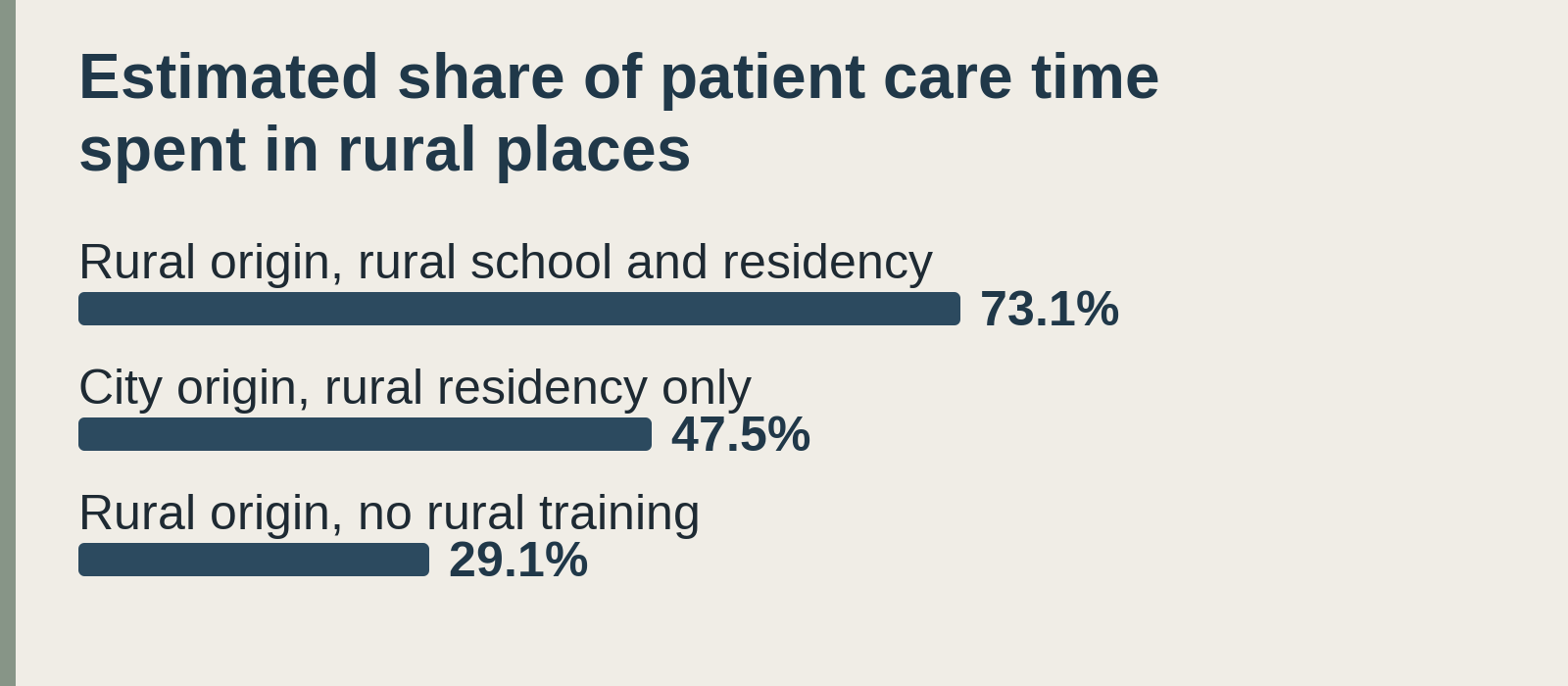
Where Doctors Settle After Training
Retention tables and survey models show residency location carries the most weight in where physicians end up.


