Anne Newland led the effort that gave northern Arizona a family medicine training program based in community clinics, and residents first reported for training there in July 2020. Programs like that one are small answers to a national question that has been argued for at least sixty years. On September 28, 1967, The New York Times ran a front page report1 under the headline that a doctor shortage was nearing a crisis, after a six week study that included interviews with federal officials, medical educators, hospital administrators and practicing physicians. The most common federal estimate, the paper said, put the shortage at 50,000 physicians.
The 1967 forecast
That figure was built from pieces. An unpublished federal estimate counted an unmet need for about 20,000 practicing physicians two years earlier, a shortage of 10,000 to 15,000 psychiatrists, and hospitals asking for some 10,000 more interns and residents1. Rashi Fein, a Brookings Institution economist, projected that demand for physician visits would grow 22 to 26 percent by 1975 over 1965 and 35 to 40 percent by 1980, driven by population growth, rising incomes, more education and the new Medicare program. On his reckoning the country would need another 50,000 doctors by 1975 on top of the existing deficit. Meanwhile American medical schools had raised their annual graduating classes only from 6,600 to about 7,600 over fifteen years, while turning away thousands of qualified applicants1.
Counting doctors versus counting care
The 1967 report already showed why a single number could mislead. The overall ratio of physicians to population had held near 150 per 100,000 for twenty years, yet the share in private family style practice, general practitioners, internists and pediatricians, had fallen from 76 per 100,000 in 1950 to 50 in 19651. Specialists had grown from about a third to almost two thirds of physicians in private practice, and only one intern in eight planned general practice, against seven in eight at the turn of the century. Full time medical school faculty had risen from 4,000 in 1952 to 18,000. Harvard's dean, Robert Ebert, warned against calling it a crisis but stressed where the pain fell.
“the situation is serious, especially in the central cities and rural areas”Robert H. Ebert, dean of Harvard Medical School, 1967, The New York Times
Towns with no doctor at all
The Times described what the national figures meant in a single place. Kirkland, Illinois, a farming community about 65 miles from Chicago, had gone two years without a full time doctor; residents raised 40,000 dollars, built a clinic on donated land, contacted at least 125 physicians and still had an empty building1. A trade publication found 1,079 towns without a doctor in 1959; by 1962 its count was 1,442, up 33 percent, and some experts put the true number above 5,000. Florida had offered medical students forgivable loans for two years of small town practice, and according to the state's medical examiners director not one recipient settled in a town without a doctor1.
The 2014 bottleneck
Nearly half a century later the argument sounded familiar. A July 2014 New York Times editorial on bottlenecks in training doctors2 cited an estimate, used by federal health department analysts, of a shortage of 16,000 primary care physicians in underserved areas as of June 19 of that year. The Association of American Medical Colleges had repeated a warning of shortfalls of 45,000 primary care physicians and 46,000 surgeons and specialists by 2020. The editorial noted that experts disagreed on the size of the gap, and that some saw a problem of distribution rather than totals: too many specialists and too few generalists, too many doctors in affluent areas and too few in poor and rural ones2. A National Health Care Workforce Commission meant to sort out the evidence had members appointed in late 2010 but never met.
The residency cap
A few days later the president of the American Medical Association, Robert Wah, answered in a letter to the Times3 that the cap on residency positions had created shortages in many regions and specialties. His group was pressing federal and state governments and private payers to pay for more residency training, and it had urged Congress to support the Creating Access to Residency Education Act of 2014, which would authorize federal grants for new residency positions3. The argument turned on a practical point: medical schools can admit more students, but a graduate cannot practice without a residency, so the number of positions sets the ceiling. How those positions are filled each spring is described in the entry on the residency match.
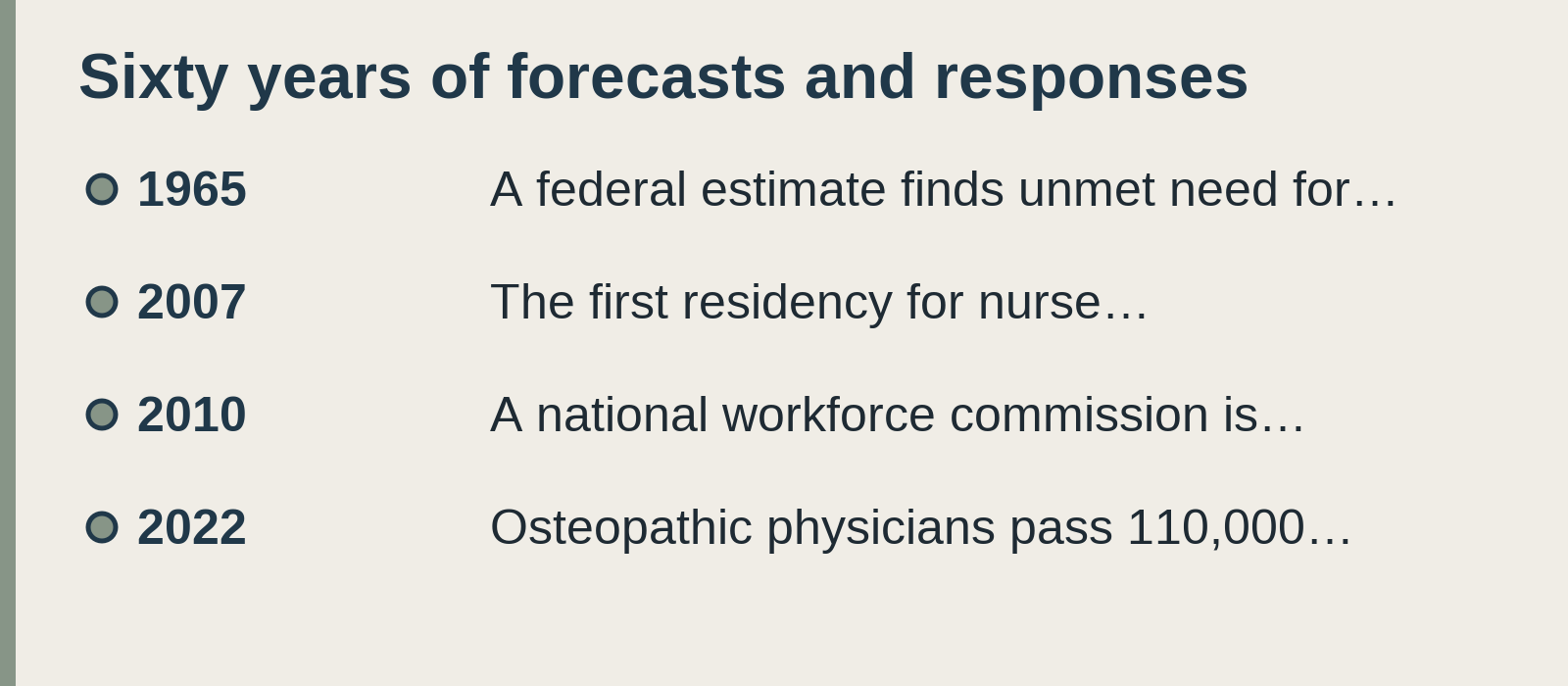
- 1965A federal estimate finds unmet need for about 20,000 practicing physicians
- 1967The most common federal estimate of the shortage reaches 50,000
- 2007The first residency for nurse practitioners opens in Connecticut
- 2010A national workforce commission is appointed but never meets
- 2014The AAMC warns of shortfalls of 45,000 primary care doctors by 2020
- 2022Osteopathic physicians pass 110,000, from under 25,000 in 1990
A different kind of doctor
Part of the answer came from a second branch of the profession. KFF Health News reported in June 20236 that the number of osteopathic physicians more than quadrupled between 1990 and 2022, from fewer than 25,000 to more than 110,000, according to the Federation of State Medical Boards, while the number of MDs rose 91 percent, from about 490,000 to 934,000. More than half of DOs work in primary care, while over two thirds of MDs work in other specialties. Osteopathic schools have more than doubled since 2000, to 40, and many of the new ones are in relatively rural states such as Idaho, Oklahoma and Arkansas6.
Iowa shows the shift at state scale. As NPR's version of the same report4 described, University of Iowa data found that from 2008 to 2022 the number of MDs based outside the state's 11 most urban counties fell more than 19 percent while the number of DOs there grew 29 percent, so DOs now make up more than a third of rural Iowa physicians. Des Moines University graduates about 210 DO students a year, compared with about 150 MD graduates from the University of Iowa4. These trends shape where graduates practice, the subject of Where Doctors Settle After Training.
Who else can fill the gaps
Nurse practitioners have taken a growing share of primary care. NPR reported in 20185, citing a Health Affairs study, that nurse practitioners made up a quarter of rural primary care providers in 2016, up from 17.6 percent in 2008, and 23 percent in nonrural areas, up from 15.9 percent. Margaret Flinter started the first nurse practitioner residency in 2007 at a Connecticut clinic network called Community Health Center, and by 2018 more than 50 postgraduate primary care programs existed nationwide5. Unlike physician residencies, these programs are voluntary, and the vast majority of the roughly 23,000 nurse practitioners who graduate each year skip them. A position statement from the Nurse Practitioner Roundtable held that extra postgraduate training is not needed to begin practice.
Why the forecasts keep changing
Each forecast in this record rested on assumptions that later moved. In 1967 the new demand came from Medicare and Medicaid putting care within reach of people who could not pay before1; in 2014 it came from millions gaining coverage and an aging population2. Specialization changed what a head count meant, as the Surgeon General observed when he said it had altered the physician to population ratio used to measure need1. The supply side changed too, as osteopathic schools multiplied and nurse practitioners took on more primary care65. And the binding limit shifted from medical school seats to residency positions3. A forecast is a snapshot of who is counted as a provider, who is expected to seek care and where both live, so when any of those changes, the number changes with it.
References
- DOCTOR SHORTAGE NEARING A CRISIS; Need for Physicians in U.S. Placed at 50,000 Many Areas Left With None Mounting Shortage of Doctors Throughout Nation Is Found Approaching a Crisis EXPERTS ESTIMATE D. The New York Times, 1967.
- Opinion | Bottlenecks in Training Doctors (Published 2014). The New York Times, 2014.
- Opinion | Needed: More Doctors in America (Published 2014). The New York Times, 2014.
- With few MDs practicing in rural areas, a different type of doctor is filling the gap. NPR, 2023.
- More Nurse Practitioners Are Pursuing Residency Training To Hone Skills. NPR, 2018.
- As Fewer MDs Practice Rural Primary Care, a Different Type of Doctor Helps Take Up the Slack KFF Health News. KFF Health News, 2023.
Further reading online
- The New York TimesDOCTOR SHORTAGE NEARING A CRISIS; Need for Physicians in U.S. Placed at 50,000 Many Areas Left With None Mounting Shortage of Doctors Throughout Nation Is Found Approaching a Crisis EXPERTS ESTIMATE D
- NPRWith few MDs practicing in rural areas, a different type of doctor is filling the gap
- KFF Health NewsAs Fewer MDs Practice Rural Primary Care, a Different Type of Doctor Helps Take Up the Slack KFF Health News
Related entries

Medical Education in Afghanistan
Rebuilt classrooms, shipped textbooks and trained counsellors, and why Afghan medical training keeps having to start again.
Where Doctors Settle After Training
Retention tables and survey models show residency location carries the most weight in where physicians end up.
Rural Training Tracks
Small town residency designs from Pennsylvania to British Columbia, the networks behind them and what their graduates do.
