A pilot's preflight checklist, run aloud before every takeoff, is the image medicine borrowed most often when it began to treat error as a design problem, and Anne Newland, once the executive clinician for improved patient care in a collaborative of the Indian Health Service and the Institute for Healthcare Improvement, spent part of her career in the broader improvement field that patient safety helped shape. This entry follows the main ideas of that safety movement and the evidence on how far it has come.
What medicine borrowed from aviation
The comparison rests on a famous disaster. A 2006 New York Times report on pilots teaching hospitals1 began with the 1977 collision of two Boeing 747s on a foggy runway in the Canary Islands, a chain of human errors that killed 583 people. Airlines answered such accidents with standard cockpit procedures, and by the mid 2000s several large hospitals had hired professional pilots to teach critical care staff communication protocols, checklists and crew briefings1. Experts disagreed on how to adapt the methods, the paper noted, but few disputed that the two fields had much in common.
The push came from a report. In 1999 the Institute of Medicine's To Err Is Human estimated that as many as 98,000 patients died each year from preventable errors1. Two safety leaders at Nationwide Children's Hospital, writing in STAT in 20182, recall that before it most physicians assumed errors were rare, harmless or unavoidable. Once those beliefs fell, hospitals built ways to detect errors, find their causes and redesign processes so they would not recur.
The authors call that approach Safety I and credit it with nearly eliminating adverse drug events at their hospital. It has limits, though, because some errors arise from situations no one has seen before. Their alternative, Safety II, treats people as an asset who can anticipate trouble, and studies the far more common days when care goes well2. In their pediatric intensive care unit they found that team responses to hard moments and healthy skepticism about new ideas made performance more reliable.
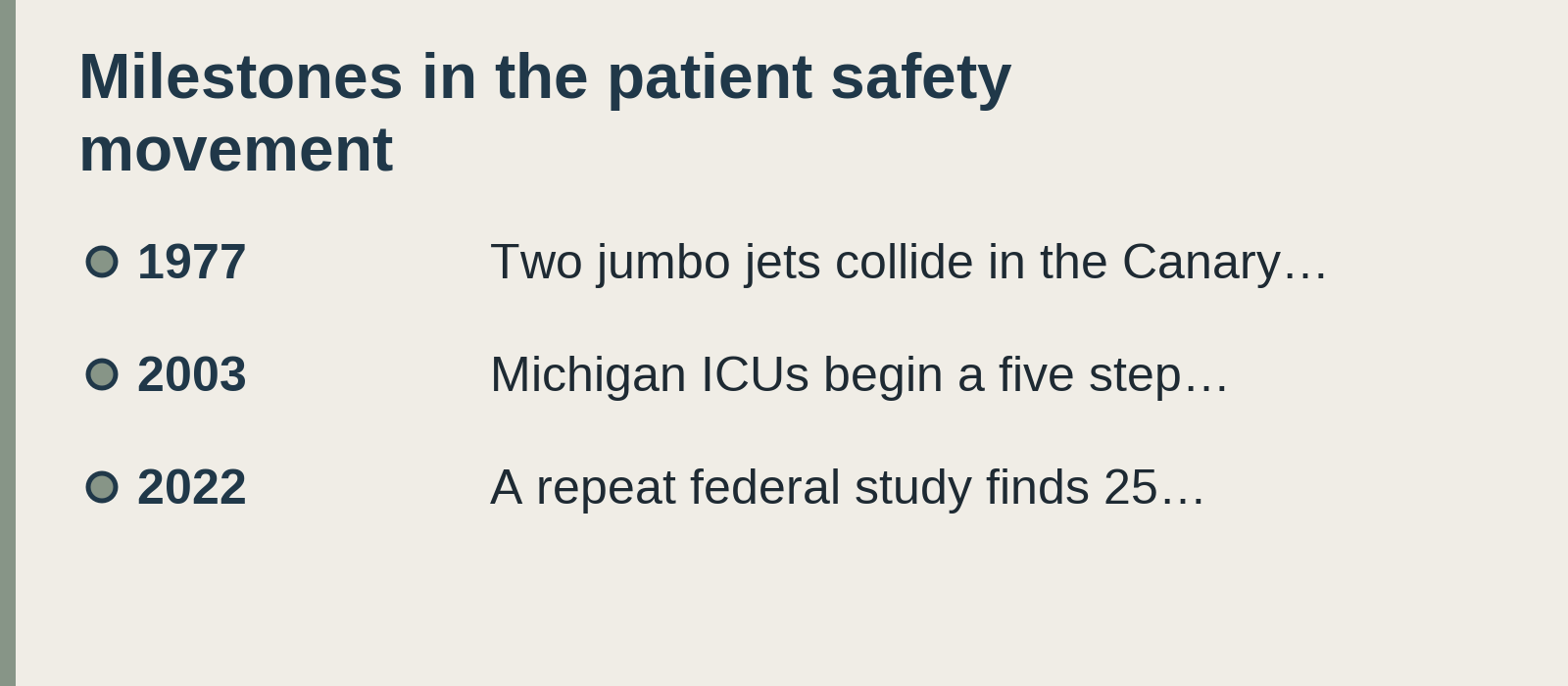
- 1977Two jumbo jets collide in the Canary Islands, killing 583 people
- 1999To Err Is Human estimates up to 98,000 preventable deaths a year
- 2003Michigan ICUs begin a five step checklist for central lines
- 2010Federal inspectors find 27 percent of Medicare patients harmed in hospital
- 2018Nationwide Children's authors propose adding Safety II to Safety I
- 2022A repeat federal study finds 25 percent; AHRQ maps safety in primary care
Checklists and the duty to speak up
The best known checklist in medicine is short. In 2003 the Michigan Health and Hospital Association asked its members to try to cut infections from central line catheters, and intensive care units at nearly every hospital in the state signed on, 103 in all. Tina Rosenberg's 2011 Fixes column in The New York Times3 lays out the five steps Peter Pronovost of Johns Hopkins designed, and the result he reported in the New England Journal of Medicine: within three months the median infection rate was zero, and it stayed there through 15 more months of follow up. Michigan hospitals then used the same approach against ventilator pneumonia with matching results, and Rhode Island adopted it too.
- 1Wash hands Clean hands before the catheter is inserted.
- 2Drape the patient Cover the patient with sterile drapes.
- 3Clean the skin Use chlorhexidine antiseptic on the insertion site.
- 4Avoid the groin Do not place the catheter in the groin area.
- 5Remove early Take the catheter out as soon as it is no longer needed.
Rosenberg argues that the list worked for a reason beyond memory. It made every member of the team responsible for the whole procedure and gave nurses explicit permission to stop a physician who skipped a step3.
“everyone is authorized to speak up”Tina Rosenberg, The New York Times, 2011, The New York Times
Hand washing shows the limits of a checklist. It must happen dozens or hundreds of times a day, and the same column reports that very few hospitals had raised hand washing rates above 50 percent. Readers and a Joint Commission project pointed to practical fixes: sinks in the same place in every room, supplies kept at the bedside, signs inviting patients to ask, and managers who treat the habit as a priority3. The federal inspectors writing in STAT make the same point about voice, urging that the whole clinical team work with patients and families and speak up when problems arise4.
Why safety is a habit, not a rule
Two decades of effort have produced less than hoped. Three officials of the HHS Office of Inspector General, in a 2022 STAT essay4, reported that their 2010 study found 27 percent of Medicare hospital patients harmed, and that a repeat using the same method found 25 percent, almost half of it preventable both times. Their examples include a patient whose urgent surgery was delayed five days and a hip replacement patient who caught a preventable MRSA infection and needed a second operation. Medication caused 43 percent of the harm, often bleeding or confusion from combined opioids. Only 5 percent of the harms appeared on the main Medicare list of hospital acquired conditions, so rules tied to that list missed most of what happened to patients.
Safety also extends beyond the hospital. An AHRQ PSNet perspective on primary care and patient safety5 lists diagnostic delays, medication events, poor communication at care transitions and missed follow up of test results as common outpatient hazards, and argues that lack of access to care can set off a cascade of harm. It ties safety to the Institute of Medicine's six aims of quality: care that is safe, effective, patient centered, timely, efficient and equitable5.
Even improvement can hurt. In a 2022 STAT essay, a Massachusetts General Hospital physician6 recounted how a quality project sent clinicians into hours of unpaid record review, and he filed an incident report about this administrative harm as he would for a clinical error. He proposed short surveys of whether clinicians feel their input is valued, so that harm to the workforce shows up early6.
Taken together, the sources describe safety as a practice rather than a rule. A rule can be written once, but the Michigan checklist worked because teams kept using it and kept the right to stop one another3. Safety II asks clinicians to keep noticing what goes right, and its authors plan end of shift debriefings to carry those lessons from one team to the next2. The persistence of harm after a decade of policy suggests that habits on the ward, more than lists in Washington, decide what happens to a patient4. Related entries on quality improvement collaboratives, redesigning primary care and community health centers follow the same ideas into clinics.
References
- What Pilots Can Teach Hospitals About Patient Safety (Published 2006). The New York Times, 2006.
- A new approach can take patient safety to the next level. STAT, 2018.
- Speaking Up for Patient Safety, and Survival. The New York Times, 1304.
- New report: gains in patient safety have stalled over the past decade. STAT, 2022.
- Primary Care and Patient Safety: Opportunities at the Interface | PSNet. Agency for Healthcare Research and Quality, 2022.
- Minimizing administrative harm: a key step to improving health care. STAT, 2022.
Further reading online
- The New York TimesWhat Pilots Can Teach Hospitals About Patient Safety (Published 2006)
- STATA new approach can take patient safety to the next level
- Agency for Healthcare Research and QualityPrimary Care and Patient Safety: Opportunities at the Interface | PSNet