Anne Newland, MD, MPH, a physician in Flagstaff, Arizona, has taught at A.T. Still University School of Osteopathic Medicine in Arizona as adjunct clinical faculty since November 2013. The university carries the name of the frontier doctor who, in 1892, opened the American School of Osteopathy in Kirksville, Missouri, and filled its first class with 21 students, six of them women1. Andrew Taylor Still was then in his sixties, and the school was the second act of an argument he had been making for eighteen years.
The gaps a country practitioner thought he saw
Still practised in Missouri in the middle of the nineteenth century and concluded that conventional treatment was failing his patients. By 1874, according to a history published by the Philadelphia College of Osteopathic Medicine2, he had settled on a founding claim: that the structure of the body and its functions are bound together, and that lasting health depends on treating that relationship rather than the symptom in front of the clinician. David Fuller, DO, who directs the second year course in osteopathic principles at the college, describes Still as holding that each person is a unified whole of mind, body and spirit, and that the body carries its own capacity to mend.
“everyone's body has an inherent ability to heal itself”David Fuller, DO, professor at the Philadelphia College of Osteopathic Medicine, Philadelphia College of Osteopathic Medicine
From that claim Still built a method: a system of diagnosis and treatment by hand, meant to sit beside the rest of medical care rather than replace it2. The association that now represents the profession dates its start to 1874 and counted the anniversary at 150 years in 20243.
The first school, and the schools that followed it
The Kirksville school opened in 1892 and a second college followed in 1898, the year the body that still represents osteopathic medical education was founded1. Philadelphia came next: the college there, opened in 1899, was the third osteopathic school in the country, and it has since added campuses in Suwanee, Georgia, in 2005 and Moultrie, Georgia, in 20192.
Growth of that kind brought a problem of definition. If the method could be taught, who decided what counted as teaching it properly, and what happened when a graduate disagreed?
A rival school and the fight over principles
The question arrived early. A 2014 article in the Journal of Osteopathic Medicine, a study of the early effort to preserve Still's principles4, describes Elmer and Helen Barber, two graduates of the school's second class, opening what they called the second school of osteopathy in 1895. Its guiding ideas, the article reports, departed sharply from the ones they had been taught, and the author treats the National School of Osteopathy as a diploma mill that the young profession had to fight.
| American School of Osteopathy | National School of Osteopathy | |
|---|---|---|
| Opened | 1892, in Kirksville, Missouri | 1895 |
| Founded by | Andrew Taylor Still, MD, DO | Elmer and Helen Barber, DO, graduates of the Kirksville school's second class |
| Guiding principles | Still's own, taught in his classrooms | Described in the journal study as sharply different from Still's |
Photographs from the period survive in the Museum of Osteopathic Medicine at Kirksville, among them Still with his son Charles Still, DO, and William Smith, MD, and the class of 1895 with Helen Barber among its graduates4. The pictures are a reminder that the profession's first quarrels were family arguments, fought between people who had sat in the same rooms.
Examinations, licenses and the slow build of standards
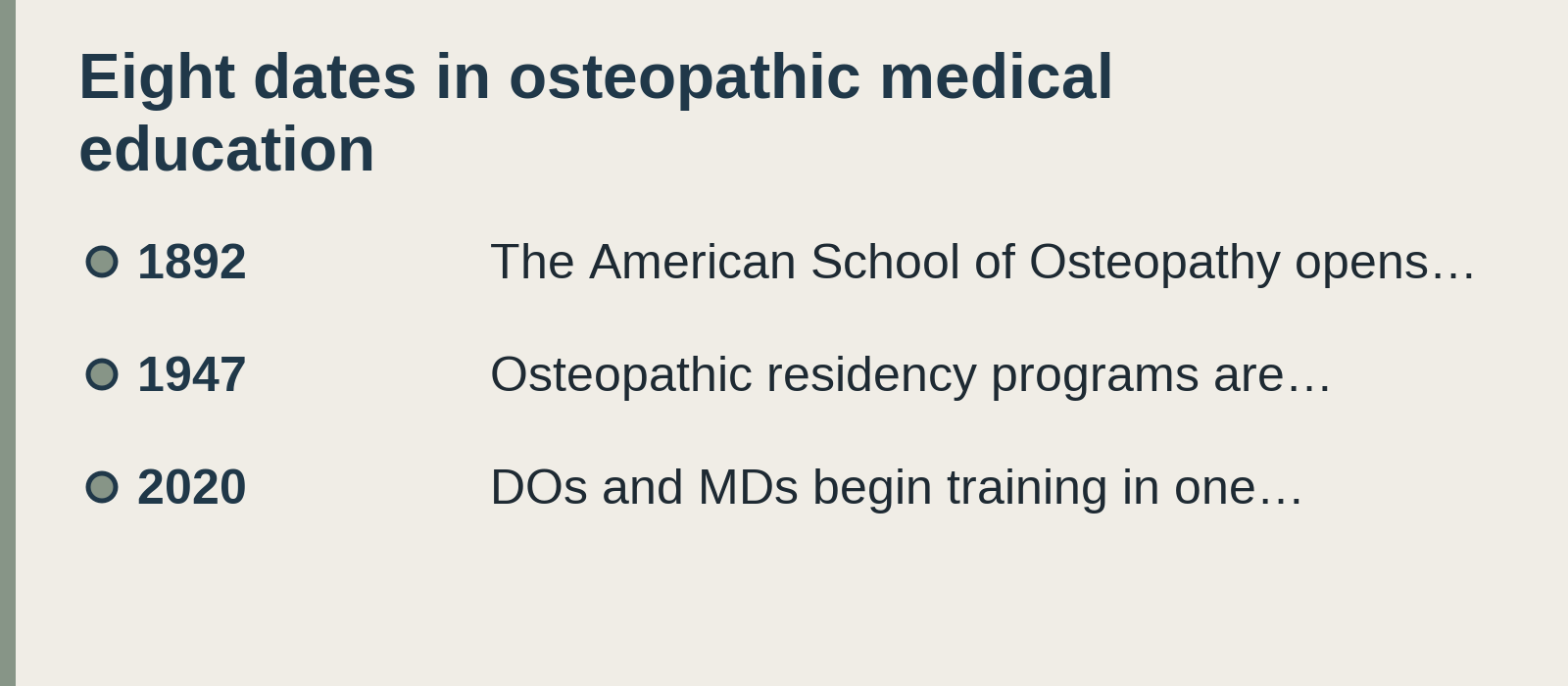
Standards came in instalments, and the dates are oddly late. The first osteopathic licensing examination was set in essay form in 1934; Margaret Barnes, DO, received her certificate two years later as the first diplomate1. Osteopathic residency programs were accredited in 1947, giving graduates an approved route into further training. In 1967 DOs became eligible for commissions in the military medical corps. Between 1995 and 1998 the National Board of Osteopathic Medical Examiners built the three levels of its own licensing examination, and in 2001 Louisiana became the last state to accept it, so that a DO could be licensed everywhere in the country on an osteopathic examination alone1.
- 1892The American School of Osteopathy opens with 21 students, six of them women
- 1898A second college opens and the colleges found their national association
- 1921Meta L. Christy, DO, becomes the first African American osteopathic physician
- 1934The first osteopathic licensing examination is set, in essay form
- 1947Osteopathic residency programs are accredited for further training
- 1967DOs become eligible for commissions in the military medical corps
- 1978More than 1,000 students graduate from the country's nine osteopathic schools
- 2020DOs and MDs begin training in one accreditation system for residencies
Who was allowed in
The record of entry runs ahead of the rest of American medicine in places and behind it in others. Meta L. Christy, DO, graduated in Philadelphia in 1921 as the first African American osteopathic physician1. In 1993 Barbara Ross Lee, DO, became the first African American woman to lead any medical school in the United States, osteopathic or not, at the Ohio University college. In 2021 women set records at both ends of the osteopathic pipeline, at 58 percent of applicants and 53.7 percent of those who enrolled, and the colleges committed jointly that year to work on inequity in admissions1.
The year the quarrel broke open
By 1961 the profession's standing was being renegotiated state by state. In California, where 2,400 osteopaths practised alongside 18,000 doctors of medicine, the two associations moved toward a merger that the American Medical Association had blessed and the osteopathic association had not; the national body revoked the charter of its California section for negotiating, and the state's osteopaths were to vote at a convention in Long Beach that May5. California's incoming medical association president argued that in some towns the best doctor in practice was an osteopath and that the barrier between the groups had stopped making sense.
Pennsylvania took the other road. The county medical society in Philadelphia published in its weekly journal, on 19 May 1961, the conclusion of an 18 month study: that osteopathic physicians practise scientific medicine, that its own ethical restrictions on working with them were lifted, and that its board of censors should set aside the national code's warning6. Glenn F. Ulansey, DO, announced the decision to the Pennsylvania Osteopathic Association's annual convention.
One accreditation system, and the size of the profession now
The argument ended in a merger of training rather than of degrees. In 2020 the osteopathic profession moved into the single accreditation system that now governs residency training, so that DOs and MDs compete for and work in the same programs1. Practice rights abroad had broadened five years earlier, to 65 countries.
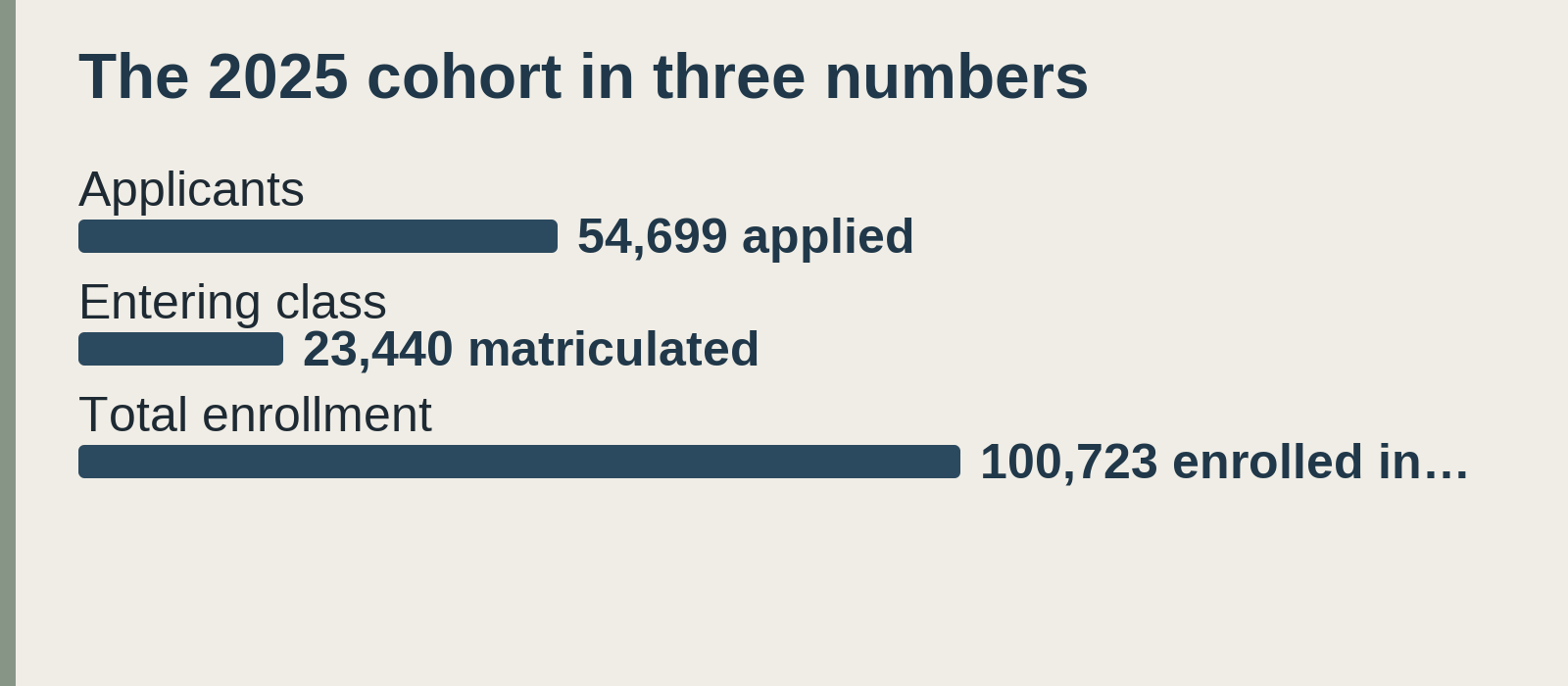
The numbers settled the rest. The association counted nearly 149,000 DOs in the United States in 2023, almost a third more than five years before, trained at some 40 accredited colleges3. The colleges report more than 34,000 students in osteopathic programs, over a quarter of everyone studying medicine in the country2. A profession that spent its first century insisting it was separate now shares examinations, residencies and wards with the one that once called it a cult, which is how a rival became a partner. What the degree still means in practice is set out in Osteopathic Medicine, the training both degrees share in Medical Students Today, and the subject as a whole in Medical School and Osteopathic Medicine.
References
- History of Osteopathic Medical Education. American Association of Colleges of Osteopathic Medicine.
- A History of Osteopathic Medicine in the United States. Philadelphia College of Osteopathic Medicine, 2022.
- Timeline: A breakdown of the history of osteopathic medicine American Osteopathic Association. American Osteopathic Association, 2024.
- Andrew Taylor Still, MD, DO, and Charles Still, DO, with William Smith,... | Download Scientific Diagram. ResearchGate.
- Members of Both Professions Would Be M.D.'s Move Is Opposed by National Osteopathic Group (Published 1961). The New York Times, 1961.
- OSTEOPATH GROUP WINS RECOGNITION; Status Approved by Medical Society in Philadelphia (Published 1961). The New York Times, 1961.
Further reading online
- American Association of Colleges of Osteopathic MedicineHistory of Osteopathic Medical Education
- Philadelphia College of Osteopathic MedicineA History of Osteopathic Medicine in the United States
- American Osteopathic AssociationTimeline: A breakdown of the history of osteopathic medicine American Osteopathic Association
- ResearchGateAndrew Taylor Still, MD, DO, and Charles Still, DO, with William Smith,... | Download Scientific Diagram
- The New York TimesMembers of Both Professions Would Be M.D.'s Move Is Opposed by National Osteopathic Group (Published 1961)
Related entries
Medical Students Today
Record enrolment, a new national competency framework, and classes that write their own oaths before the first lecture.
Viruses as Gene Delivery Tools
Delete the genes a virus needs to multiply, insert a human gene, and measure how long the cell reads it.
Osteopathic Medicine
Two sets of letters, one licence to practise, and a tradition that now trains a quarter of American medical students.

