Anne Newland is a physician who draws comics of her own and is active in the Graphic Medicine International Collective, part of a field whose most practical branch is the comic written to teach health. That work often ends up somewhere ordinary: a wire rack on a clinic wall, where a booklet with a cartoon cover sits among pamphlets on blood pressure and diet. A 2018 case in the AMA Journal of Ethics1 begins with exactly such a rack. A psychiatrist hands a woman with post traumatic stress after a car crash a comic booklet called Trauma and You, and she throws it away outside the door, insulted to be given what she takes for a children's book.
A long history of teaching with pictures
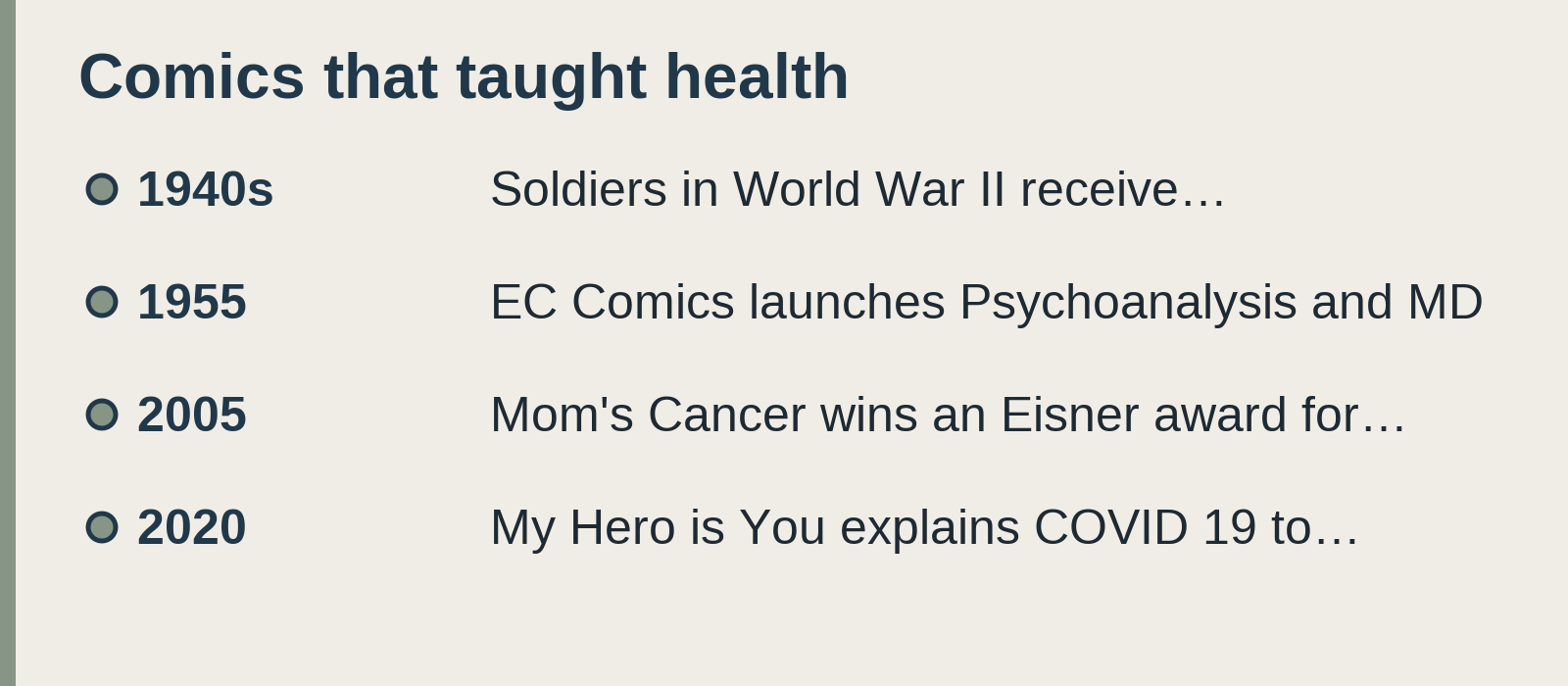
Comics taught health long before anyone called it graphic medicine. MK Czerwiec, a nurse and cartoonist, points in a 2018 essay for STAT2 to the posters, leaflets and comics given to soldiers in World War II about avoiding sexually transmitted diseases, and notes that patient handouts with images in sequential boxes are comics too. Doctors also became comic characters: Rex Morgan, M.D., a daily newspaper strip, was created in 1948 by the psychiatrist Nicolas P. Dallis, and in 1955 EC Comics launched two titles, Psychoanalysis and MD, that treated medicine soberly, as The Guardian reported in 20103.
- 1940sSoldiers in World War II receive posters and comics about sexually transmitted diseases
- 1948The psychiatrist Nicolas P. Dallis creates the strip Rex Morgan, M.D.
- 1955EC Comics launches Psychoanalysis and MD
- 1987Howard Cruse's strip Wendel takes up AIDS
- 2005Mom's Cancer wins an Eisner award for best digital comic
- 2018A National Library of Medicine exhibition on graphic medicine is on display
- 2020My Hero is You explains COVID 19 to children around the world
Why pictures help readers understand health
The problem comics address is reading level. More than one third of Americans have low health literacy, and most patient materials at the point of care are written well above the reading level of the average adult, according to a 2025 scoping review by nursing and public health researchers at Emory and elsewhere6. An earlier systematic review the authors cite found that pairing pictures with text improves attention to health messages, recall, understanding and intention to act. The AMA case commentary explains the mechanics: a comic can show a sequence of actions that would take paragraphs to describe, and it can set a normal airway beside an asthmatic one so the difference is plain1.
Comics written for children
Children are the most studied audience. The Emory review cites a randomized study of 364 children in which story format materials improved comprehension compared with standard text6. Its trials covered safe sleep, concussion, epilepsy, back pain and nutrition, and one illustrated book used sign language to teach oral health to children aged 6 to 10 with hearing loss. The commentary on Trauma and You also lists The Adventures of Iggy and the Inhalers, a 2015 asthma comic for children by Alex Thomas and a coauthor, among comics that set normal and asthmatic airways side by side1.
How comics explained COVID 19 to children
When schools closed in 2020, scientists and child psychologists teamed up with artists to explain the virus. Marina Joubert of Stellenbosch University, writing in The Conversation5, surveyed the results. My Hero is You, produced by United Nations agencies and dozens of humanitarian groups, features a creature named Ario; its writer, Helen Patuck, drew on input from more than 1,700 children, parents, caregivers and teachers, and translations were under way in more than 100 languages. India's health ministry issued a comic with a superhero called Vaayu, the graphic novelist Sonny Liew worked with an infectious disease specialist in Singapore, and the South African poet Athol Williams wrote Oaky and the Virus in English, isiZulu, Siswati, Sepedi and Tshivenda.
“make complex topics more meaningful to diverse audiences”Marina Joubert, summarizing research on educational comics in The Conversation, The Conversation
Are comics suitable for adult patients
The Trauma and You case asks that question directly. Its authors argue that in the United States many adults see comics as juvenile and meant to be funny, so a clinician should explain why a particular comic suits a particular patient1. They separate memoir comics, valuable mainly for showing feelings and concepts, from instructional comics that explain conditions and treatments. Because comics rarely appear in standard collections of reviewed patient materials, they add, clinicians must check each one for accuracy themselves. The comics historian Paul Gravett told The Guardian that adult resistance will fade as readers see the form can handle illness seriously3.
Comics and changing health behavior
Emma Berry, a health psychologist at Queen's University Belfast, describes in a 2022 piece for The Conversation7 how comics can explain treatments, help people keep taking medicines, ease anxiety before surgery and encourage screening. Readers who identify with a character may copy behavior that turns out well in the story, a process psychologists call modelling. Berry developed a comic called Diabetes Cyberspace with young people living with type 1 diabetes in the UK, Ireland and Denmark, about how social media content affects their wellbeing. She is frank that most evidence so far is speculative or comes from small qualitative studies.
What randomized trials have found
The Emory team went looking for harder evidence. They searched nine databases and found 34 randomized trials of still image interventions, run on five of the six inhabited continents6. The results were mixed, and only one study tested effectiveness in everyday care rather than efficacy under trial conditions.
| Participants | What happened | |
|---|---|---|
| Comic leaflet before surgery | Children aged 6 to 12 | No significant drop in anxiety |
| Comic with consent forms | Adults before coronary procedures | Significant drop in anxiety |
| Sleepy Baby booklet | Mothers of low socioeconomic status | Less bed sharing, more crib use |
| Illustrated pill schedule | Patients taking medicines | No change in adherence |
| Tailored cartoon sessions | Adolescents in Thailand on HIV treatment | Better adherence |
| Adam Goes to Surgery | Children in day surgery | Not superior to medication |
Comics against stigma
Some health comics work by making hard subjects speakable. Czerwiec, who nursed on an inpatient AIDS unit in Chicago that opened in 1985 and closed in 2000, writes in the AMA Journal of Ethics4 that AIDS comics fell into three groups: health education, activism and testimony. Community groups used cheap, low tech comics to explain how to avoid HIV, often aimed at particular age and risk groups. Mental health is another frontier. The British cartoonist Gemma Correll told BBC News in 20218 that she found it so hard to describe her feelings aloud that she would write them down and hand the paper to her doctor, and one reader told her a comic had finally put words to feelings they could not express.
What a picture can explain
Brian Fies's Mom's Cancer, which won an Eisner award in 2005, shows how one memoir can serve as patient education; nursing instructors in Australia used it to train students, Fies told The Guardian3. He drew his mother drowning in medical jargon and walking a tightrope as she balanced her medicines, metaphors a leaflet can only name. A leaflet lists side effects and steps; a picture shows a person getting through them, in an order the eye can follow and return to. More on the field appears in graphic medicine, its key titles in books of graphic medicine, and related arts under comics, music and medicine.
References
- Are Comic Books Appropriate Health Education Formats to Offer Adult Patients? , Feb 2018 | Journal of Ethics | American Medical Association. American Medical Association.
- Getting graphic in medicine: using comics to tell health stories. STAT, 2018.
- Comics put patients in the picture. The Guardian, 2010.
- Representing AIDS in Comics , Feb 2018 | Journal of Ethics | American Medical Association. American Medical Association.
- Comics and cartoons are a powerful way to teach kids about COVID 19. The Conversation, 2020.
- A Scoping Review of Graphic Medicine Interventions to Promote Changes in Health Behavior, Health Service Engagement, and Health Outcomes. National Institutes of Health, 2025.
- From health to the environment, how comics could drive behaviour change. The Conversation, 2022.
- The cartoonists making mental health their muse. BBC, 2021.
Further reading online
- American Medical AssociationAre Comic Books Appropriate Health Education Formats to Offer Adult Patients? , Feb 2018 | Journal of Ethics | American Medical Association
- STATGetting graphic in medicine: using comics to tell health stories
- The GuardianComics put patients in the picture
- The ConversationComics and cartoons are a powerful way to teach kids about COVID 19
- National Institutes of HealthA Scoping Review of Graphic Medicine Interventions to Promote Changes in Health Behavior, Health Service Engagement, and Health Outcomes
- BBCThe cartoonists making mental health their muse
Related entries

Music and Medicine
Bedside cellos, drumming circles for Parkinson's disease and orchestras of doctors: what music does in medicine.

The Medical Humanities
Novels, paintings, plays and comics in the medical curriculum, and the case for keeping them there.
Graphic Medicine
Comics about illness, caregiving and clinical work, and the artists, nurses and doctors who turned them into a field.


