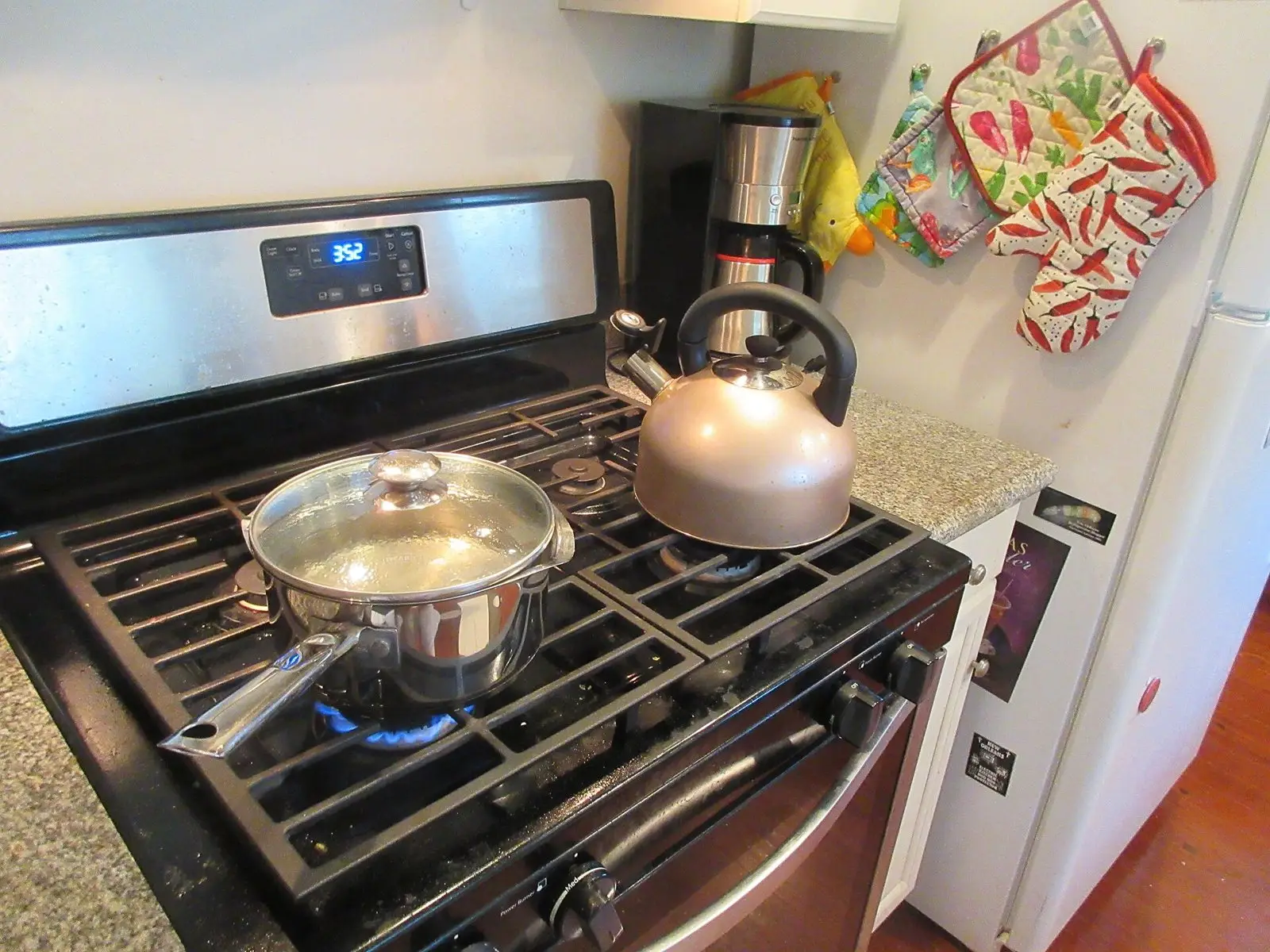
A pot of green chile on the stove is ordinary cooking across the Southwest, and cooking itself is one of the interests Anne Newland pairs with cycling and reading. In the last few decades home cooking has also become a subject of medical research and teaching, as physicians look for ways to turn nutrition advice into meals people actually make.
Red or green
The chile pot is a good place to start because it shows cooking as skill rather than formula. Bon Appétit's collection of New Mexico chile recipes1 explains that diners in traditional New Mexican restaurants are asked "red or green?", meaning which chile sauce they want, and that cooked green chile sauce goes with nearly everything in the state, from eggs to roast beef.
Fresh green chiles fill roadside stands in late summer and fall, where they are often roasted on the spot in hand turned drums. In northern New Mexico the ripe red pods are strung into ristras to dry by doorways, then kept for winter sauces. Red chile sauce, made by soaking dried pods in hot water and blending them with garlic, is the base of carne adovada, pork browned and then slow cooked in the sauce1. A cook who knows how to roast, rehydrate and blend a chile can make a dozen dishes from it, which is the same principle the physician cooks below teach.
What home cooking does to a diet
The main evidence comes from national survey data. A 2014 Johns Hopkins Center for a Livable Future report2 describes a study by Julia Wolfson and Sara Bleich of more than 9,000 adults in the 2007 to 2010 National Health and Nutrition Examination Survey. The 8 percent who cooked dinner once a week or less ate, on an average day, 2,301 calories, 84 grams of fat and 135 grams of sugar. The 48 percent who cooked six or seven nights a week ate 2,164 calories, 81 grams of fat and 119 grams of sugar.
| Cook dinner once a week or less | Cook dinner six or seven nights | |
|---|---|---|
| Share of adults | 8 percent | 48 percent |
| Calories on an average day | 2,301 | 2,164 |
| Fat | 84 grams | 81 grams |
| Sugar | 135 grams | 119 grams |
Frequent cooks also ate fewer calories when they did eat out, relied less on frozen food and chose fast food less often. People working more than 35 hours a week outside the home cooked less, and the authors named time and money as real barriers2. An American Society for Nutrition article3 adds that Americans have been eating away from home more, a 42 percent increase, and preparing food at home less, a 25 percent decrease.
What culinary medicine is
The response inside medicine has a name. The nutrition society article defines culinary medicine as an evidence based field that joins the art of food and cooking with the science of medicine, focused on practical skills such as shopping, storing food and preparing meals3. It reports that about 30 institutions in the United States teach it, and describes Rani Polak's CHEF coaching program at Spaulding Rehabilitation Hospital, which meets clients weekly for 12 weeks and had just been funded for a three year multicenter randomized trial.
An AMA profile of the internist Linda Shiue4 calls culinary medicine applied nutrition that gives patients practical, personal guidance. She begins with simple questions: what a patient likes to eat, which flavors they enjoy and what makes change hard. Then she suggests small steps that fit the patient's budget, culture and taste.
Teaching kitchens for doctors
Doctors often learn to cook at conferences. A 2018 New York Times account5 describes Healthy Kitchens, Healthy Lives, where 80 physicians from across North America spent three days in a Northern California teaching kitchen dicing onions, cooking grains and lentils, reading nutrition labels and practicing motivational interviewing. The writer described it as completing its 15th year that spring.
The sources differ on its age. A 2025 article from the Harvard Chan School6 says David Eisenberg founded the conference in 1998, with colleagues from the school and the Culinary Institute of America, which would make it older than the Times account implies. Eisenberg, whose father died of a heart attack at 39, has taught physicians cooking skills for more than 25 years and stresses basic techniques over recipes.
- 1998David Eisenberg founds Healthy Kitchens, Healthy Lives, by Harvard's account
- 2014Johns Hopkins researchers link frequent home cooking to a healthier diet
- 2016Linda Shiue joins The Permanente Medical Group in primary care
- 2017Thrive Kitchen opens; the Times reports on chefs teaching in New York schools
- 2018The Times describes Healthy Kitchens, Healthy Lives in its 15th year
- 2025The AMA profiles Thrive Kitchen and a medical school cooking elective
Cooking lessons for patients and students
Shiue came to the field through that conference and began teaching patients to cook less than a week later4. In 2017 she opened Thrive Kitchen at Kaiser Permanente San Francisco, building on farmers markets her predecessor had started for patients; its classes moved online when COVID 19 arrived and send each participant home with five plant based recipes. She also helped build a month long culinary medicine elective at the Kaiser Permanente School of Medicine that now has a two year waitlist, and estimates that medical school otherwise offers maybe 20 hours of nutrition in four years.
Children learn in school kitchens too. A 2017 Times report7 visited P.S. 333 on Manhattan's Upper West Side, where students in a rooftop greenhouse prepared kale and zucchini for lunch under the chef Yadira Garcia, placed there for three years by Wellness in the Schools. Founded by the former teacher Nancy Easton, the nonprofit then reached 50,000 children in four states.
What a kitchen teaches
The sources suggest that the lesson of a kitchen is method. Eisenberg's example is the stir fry: once a cook understands high heat, oil and a few aromatics, the vegetables and proteins can change endlessly6.
“If you can make one, you can make a thousand”David Eisenberg, physician and culinary nutrition teacher at Harvard, Harvard University
The nutrition society writer reached the same idea from the grocery aisle, buying ingredients that could be cooked once and used several ways during the week3. Shiue's classes teach roasting, sautéing and seasoning so that vegetables taste good4, and the Wellness in the Schools chefs work to make healthier versions of foods children already like7. The open questions are practical ones, such as whether families without a blender or home internet can follow the lessons3. Related entries on cycling and health, wilderness medicine and reading for pleasure belong to the outdoors and home section.
References
- New Mexico Chile. Bon Appetit.
- Study Suggests Home Cooking is a Main Ingredient in Healthier Diet. Johns Hopkins Bloomberg School of Public Health.
- The Art of Cooking for Health: Culinary Medicine , American Society for Nutrition. American Society for Nutrition.
- From kitchen to clinic: Transforming care with culinary medicine. American Medical Association, 2025.
- The Doctor Is Cooking (Published 2018). The New York Times, 2018.
- Teaching physicians and their patients healthy cooking skills for a lifetime | Harvard T.H. Chan School of Public Health. Harvard University, 2025.
- Reading, Math and Sushi: Cooking as a Health Lesson (Published 2017). The New York Times, 2017.
Further reading online
- Bon AppetitNew Mexico Chile
- Johns Hopkins Bloomberg School of Public HealthStudy Suggests Home Cooking is a Main Ingredient in Healthier Diet
- American Society for NutritionThe Art of Cooking for Health: Culinary Medicine , American Society for Nutrition
- American Medical AssociationFrom kitchen to clinic: Transforming care with culinary medicine
- The New York TimesThe Doctor Is Cooking (Published 2018)
- Harvard UniversityTeaching physicians and their patients healthy cooking skills for a lifetime | Harvard T.H. Chan School of Public Health


