
Anne Newland, who belongs to the World Professional Association for Transgender Health, has said she would like to write and talk about the health of transgender people, gender affirming care included. In a clinic, that subject often starts on a clipboard. An older intake form asks for sex with two boxes, male and female; a revised one asks separately for current gender identity and for sex assigned at birth, then offers a line for the name a patient uses and a space for pronouns. A 2018 commentary in American Family Physician1 urged every primary care office to drop the binary choice in favor of inclusive wording, and a review in the same issue2 described the two step method, a pair of questions that records both facts without guesswork.
Why primary care is the usual setting
For years, transgender patients were sent to endocrinologists, and early published guidance was written for that specialty. STAT reported in July 20193 that the American College of Physicians had issued its first guidelines on transgender care, aimed this time at internists and family doctors, and quoted Joshua Safer of the Mount Sinai Center for Transgender Medicine and Surgery saying the work falls within their scope. The arithmetic supports the shift. An estimated 1.4 million American adults identify as transgender, and the 2018 review adds about 150,000 young people2. An Illinois family physician told STAT that a doctor who sees 5,000 patients a year will meet a couple dozen gender diverse people, knowingly or not.
“You’re seeing gender diverse people all the time”Frederic Ettner, family physician, quoted by STAT, STAT
The main professional society of family doctors, the AAFP (American Academy of Family Physicians), takes the same position in its policy on transgender and nonbinary patients4. The policy calls gender affirming care part of comprehensive primary care for many patients and argues that family physicians suit the work because they treat the whole person across a lifetime. It asks physicians who do not offer this care to refer patients to someone who does, and it backs teaching about gender diversity in medical school, in residency and in continuing education.
The barriers patients describe
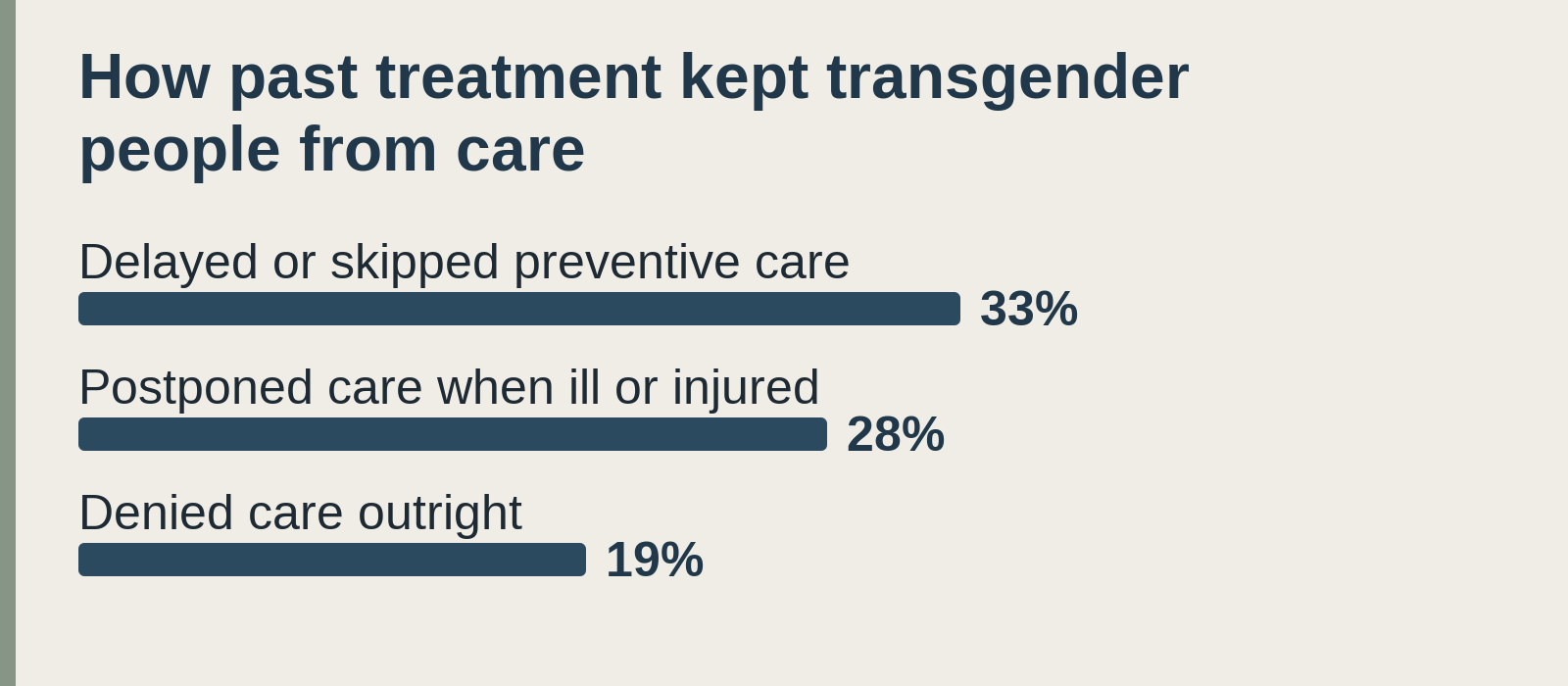
Surveys of transgender adults keep finding the same obstacles. The 2018 review cites a large observational study in which 24 percent reported unequal treatment in health care, 19 percent had been refused care outright and 33 percent did not seek preventive services; about half had taught a clinician the basics of their own care2. The companion commentary adds that gaps persist in colorectal and cervical cancer screening, in blood pressure and cholesterol checks and in influenza vaccination1.
Distance makes it harder. In August 2022, Fenway Health summarized a study in the journal LGBT Health5 of 244 transgender and gender diverse adults in rural counties of Connecticut, Massachusetts, New Hampshire, New York and Vermont. One quarter had no access at all to gender affirming primary care, and nearly 10 percent had been turned away by a doctor. Fifty nine percent described a lack of clinical skill among clinicians, and about a fifth had never been tested for HIV. Access also varied by identity, as the chart shows.
Building a welcoming practice
Practical advice on setting up a program arrived in January 2020, when Annals of Family Medicine published what Fenway Health called the first peer reviewed guide to adding transgender health programs to existing primary care practices6. Practices with resources were told to begin by consulting local transgender community leaders through focus groups and interviews. Smaller ones could start by training clinicians in current guidelines and building a referral network for surgery and other outside services. The advice was meant to scale from an office with one or two trained clinicians to a center offering mental health, voice therapy and surgical care.
Plenty of this happens before a clinician enters the room. The paper lists clearly labeled all gender restrooms, posted nondiscrimination policies and intake forms with space for chosen names, pronouns and the names on insurance and identity documents. The AAFP's online toolkit for family physicians7 points practices to training modules and glossaries, and it flags a quieter hazard: an insurer's explanation of benefits statement can disclose sensitive services, gender affirming care among them, to whoever opens the mail. A Stanford obstetrician told STAT that a well trained physician is not enough if receptionists, billing staff and medical assistants are not affirming, because the patient may never reach the exam room3.
| What guidance suggests | |
|---|---|
| Intake form | Separate questions for gender identity and sex at birth, plus name and pronouns |
| Front desk | Staff trained to use correct names and pronouns |
| Waiting room | Materials and images that show diverse patients and families |
| Restroom | At least one clearly labeled all gender restroom |
| Health record | Fields for gender identity rather than male, female and undifferentiated |
Preventive care follows anatomy
Once the visit begins, most of primary care looks familiar. The AAFP's 2023 summary of the WPATH guidelines8 says that most primary care needs of transgender and gender diverse patients match those of anyone the same age. It notes higher rates of cardiovascular disease, partly because risk factors go undertreated, and recommends standard attention to blood pressure, cholesterol and smoking. Screening follows the organs a person has: the College's guidance, as STAT reported it, calls for cancer surveillance based on present organs rather than gender identity, and the WPATH summary says cervical screening should be offered to everyone with a cervix.
The 2018 review adds that the history and examination should fit the reason for the visit and be explained in advance, with a chaperone offered and the exam stopped when the patient wishes2. It recommends routine screening for depression, anxiety, substance use and similar concerns, while warning clinicians not to assume such problems stem from being transgender. Depending on their comfort and on specialists nearby, primary care clinicians may take an active part in gender related care or a supporting one, watching overall well being and arranging referrals.
Why the primary care door matters most
The argument for primary care rests on continuity. STAT noted that internists often keep relationships with their patients for many years, so an internist may be the first clinician with whom someone discusses gender identity and the goals of care3. The academy's policy makes the same point about family physicians4. A clinician with little training need not wait to become an expert: the 2018 commentary suggests being candid about limited experience while promising to learn and to keep the office safe1. The guidelines behind that learning are traced in the Standards of Care, while training clinicians in transgender health follows the teaching itself.
The door is meant almost literally. A revised form, a receptionist who uses the right name and a current referral list decide whether a patient comes back for the next blood pressure check, cervical screening or flu shot. In the rural study, the quarter of participants with no affirming primary care at all had nowhere ordinary to start5. How the conversation inside the room should go is the subject of talking with transgender patients, and related entries are gathered under transgender health.
References
- The Responsibility of Family Physicians to Our Transgender Patients. American Academy of Family Physicians, 2018.
- Caring for Transgender and Gender Diverse Persons: What Clinicians Should Know. American Academy of Family Physicians, 2018.
- New guidelines aim to enlist primary care physicians in transgender care. STAT, 2019.
- Care for the Transgender and Gender Nonbinary Patient. American Academy of Family Physicians.
- New Study Finds Significant Barriers to Gender Affirming Primary Care among Transgender People Living in Rural Areas Fenway Health. Fenway Health, 2022.
- New Paper Provides Blueprint for Building Transgender Health Programs in Primary Care Settings Fenway Health. Fenway Health, 2020.
- LGBTQ+ care: Clinical guidance for family physicians. American Academy of Family Physicians.
- Caring for Transgender and Gender Diverse People: Guidelines From WPATH. American Academy of Family Physicians, 2023.
Further reading online
- American Academy of Family PhysiciansThe Responsibility of Family Physicians to Our Transgender Patients
- STATNew guidelines aim to enlist primary care physicians in transgender care
- Fenway HealthNew Study Finds Significant Barriers to Gender Affirming Primary Care among Transgender People Living in Rural Areas Fenway Health
Related entries

Training Clinicians in Transgender Health
From a few lecture hours to required hospital sessions and video mentoring, and why the gaps show up in patients' health.

Gender Incongruence in the ICD
The World Health Organization's disease codes, the old categories for gender identity, and the new chapter that replaced them.
Talking With Transgender Patients
Names, pronouns, relevant questions and plain words: what patients say makes a clinical conversation about gender work.


