
Anne Newland graduated from Barnard College in 1990, cum laude, after studying German together with political science. From 1993 she was back on campus teaching the beginning biology lab sections, and she later became assistant director of those laboratories.
The college gives its address as 3009 Broadway, and a gate on that avenue opens onto a small, leafy campus in upper Manhattan. Across the street stands Columbia University, whose classrooms, libraries, playing fields and even dining halls Barnard students share, according to the college's own overview1. That arrangement, a separate women's college pressed up against a large university, is the thread running through Barnard's history. It began as a compromise and survived several moments when it could have ended, and it sits at the center of this site's college years entries.
How Barnard began in 1889
In the 1880s Columbia admitted only men. Its president, Frederick A. P. Barnard, had led the college since 1864 and spent nearly 25 years turning a small undergraduate school into a major university, according to Britannica's biography of him2. He also pressed the trustees to open Columbia to women. They turned down his plan for coeducation, and the women's college that opened in 1889 as a kind of annex was named for him. He died that April.
Barnard's own account of its history3 gives the credit for the founding to Annie Nathan Meyer, a young writer and student who gathered a committee and petitioned Columbia's trustees for two years. Before that, the university had offered women only a syllabus they could study for a certificate, without a seat in regular classes. The new college was the only place in New York City, and one of few in the country, where women could get an education matching the one Columbia gave men.
The money was thin. A 1939 New York Times review of the college's fiftieth anniversary history noted that Barnard started without an endowment or land, backed only by fewer than fifty people who promised $100 a year for four years4. The first class met in a rented brownstone at 343 Madison Avenue, a few blocks from Grand Central, with six faculty members and 14 students3. Nine years later the college moved uptown to Morningside Heights, where it remains.
- 1864Frederick A. P. Barnard becomes president of Columbia
- 1889Barnard opens in a rented brownstone on Madison Avenue
- 1898The college moves to Morningside Heights
- 1900Barnard joins Columbia's educational system on its own terms
- 1917Students' Hall, later Barnard Hall, opens
- 1983Columbia College admits women; Barnard stays independent
- 2016Barnard begins admitting transgender women
- 2023Laura Rosenbury becomes the ninth president
“Probably no institution was ever founded more purely on faith.”The authors of Barnard's fiftieth anniversary history, quoted by The New York Times, 1939, The New York Times
A college inside a university
The terms set in 1900 were unusual among women's colleges. Barnard entered Columbia's educational system but kept its own trustees, faculty and dean, and stayed responsible for its own endowment and buildings, while sharing Columbia's instruction, its libraries and its degree3. Barnard was also one of the original Seven Sisters, the group of East Coast women's colleges.
The arrangement faced its hardest test in 1983, when Columbia College began admitting women, the change Frederick Barnard had argued for more than a century earlier. The college's history says many expected Barnard to be absorbed. Its president at the time, Ellen Futter, fought to keep it independent and negotiated a new agreement with the university. Accounts differ in how they describe the result: the National Park Service's page on Barnard Hall5 says Barnard later merged with Columbia while keeping its identity as a smaller school, whereas the college itself describes a partnership between two separate institutions that it calls unique in American higher education1.
Barnard Hall and the students of 1916
The building at the center of the campus was first called Students' Hall. It went up in 1916 and opened the following year, designed by the firm of Arnold W. Brunner and Associates, the Park Service records5. The architects' floor plans show a gymnasium, a stage, offices for students and faculty, lunchrooms, a kitchen and rooms for ice cream and pastry. The hall was renamed for Frederick Barnard and covers about 79,000 square feet. It was listed on the National Register of Historic Places on November 15, 2003.
The Park Service tells the building's story through Mabel Ping Hua Lee, who arrived in New York from Guangzhou in 1905 and rode on horseback in the 1912 suffrage parade on Fifth Avenue a year before starting at Barnard. As a student she published an essay on the meaning of woman suffrage and led the Philosophy Club. New York women won the vote in 1917, but the Chinese Exclusion Act of 1882 barred Lee from citizenship until its repeal in 1943, so she stayed unable to vote long after graduating.
Lee was one of many activists. Barnard students picketed and held mock elections during the campaign for the 19th Amendment, and in 1968 they occupied buildings and helped push Barnard and Columbia to change policies3. The college counts the anthropologist Margaret Mead, class of 1923, and the novelist Zora Neale Hurston, class of 1928 and Barnard's first Black graduate, among its alumnae.
Who studies at Barnard now
The college reports 324 full time faculty as of fall 2025, a 97 percent rate of first year students returning for a second year, and 61 percent students of color among its domestic students1. Laura Rosenbury, a legal scholar of women and gender, became its ninth president in 2023. In October 2026 the college adopted written principles on freedom of expression and academic freedom and a policy of institutional neutrality.
Family wealth tells a more complicated story. A 2017 analysis by The Upshot at The New York Times6, built on anonymous tax records for students born around 1991, put the median family income of Barnard students at $190,100, with 65 percent from the top fifth of earners. Yet 6.6 percent came from the bottom fifth, second highest among the 65 elite colleges in its comparison. About 3.5 percent of students moved from the bottom fifth as children to the top fifth as adults.
Over more than 130 years Barnard has held on to the things its founders fought for: a college run for women, with its own faculty and its own leaders, across the street from a university that once shut them out. What changed is nearly everything around that core. The rented brownstone became a campus and the certificate became a Columbia degree. The student body, once 14 women, has included transgender women since 20163, and its students now arrive from nearly every state and dozens of countries, the college says1.
References
- About Barnard | Barnard College. Barnard College.
- Frederick Barnard | Educator, Columbia University, President | Britannica. Encyclopaedia Britannica, 1998.
- A Fearless History | Barnard College. Barnard College.
- Barnard College The First Fifty Years (Published 1939). The New York Times, 1939.
- Barnard Hall at Barnard College (U.S. National Park Service). National Park Service.
- Economic diversity and student outcomes at Barnard. The New York Times, 2017.
Further reading online
- Barnard CollegeAbout Barnard | Barnard College
- Encyclopaedia BritannicaFrederick Barnard | Educator, Columbia University, President | Britannica
- The New York TimesBarnard College The First Fifty Years (Published 1939)
- National Park ServiceBarnard Hall at Barnard College (U.S. National Park Service)
Related entries
Political Science as a Discipline
From an 1886 quarterly to peer review, the gender citation gap and the long argument over rigor and relevance.
Studying German in America
Immigrant schoolrooms, a teachers' meeting at Columbia, six proficiency levels and the reasons students still pick German.
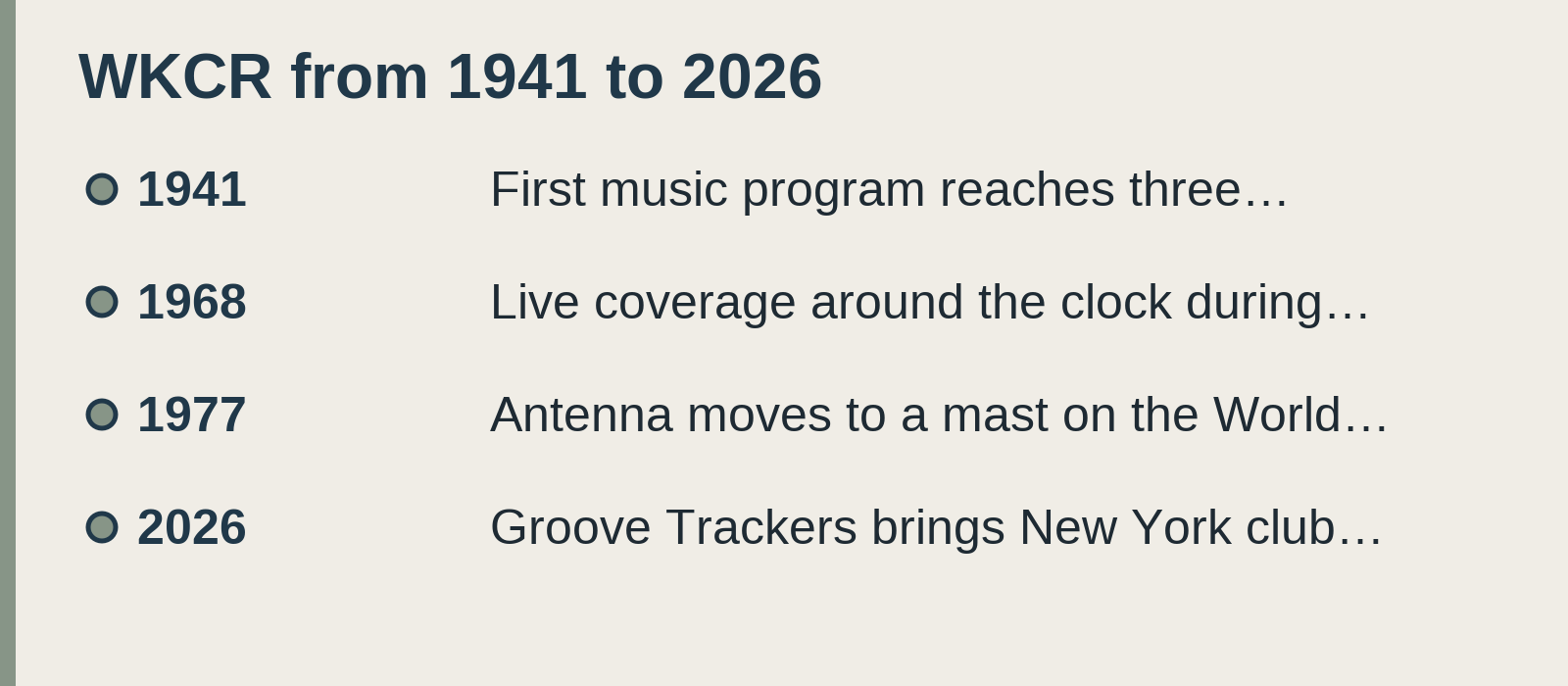
WKCR, Columbia's Radio Station
Columbia's student station, from a two watt dormitory signal to music festivals running hundreds of hours.


